Sunday, 19 March 2023

Woman's History Month...2023. Post 18... Poor Sisters Of Our Lady...Subiaco (1951).

Woman's History Month...2023. Post 18... Poor Sisters Of Our Lady...(1961).

This month is Women's History Month. I have decided to repost the stories of many of the wonderful women from Subiaco I have come across.

Poor Sisters Of Our Lady...Subiaco (1951).

This is another wonderful story from Ken Spillman's book 'Tales of a singular city. Subiaco since the 1970's' about the work of the Poor Sisters of Our Lady in Subiaco from 1951 to 1999.

The Poor Sisters of Our Lady established a home which they named 'Marianum' at 14 Heytesbury Road, Subiaco. The home was opened in 1953 and reported in newspapers on Trove...

"A festival will be held on Sunday to mark the opening of the first home in Australia of the Hungarian order of the Poor Sisters of Notre Dame of Kalocsa. A house at 14 Heytesbury Road, Subiaco, will be the new home for 16 Hungarian sisters of the order. They came to this State last year after having worked for 25 years in China. They were forced by the Communists to leave China. They hope soon to open a home for elderly women and later a home for the children of working mothers. The new premises will be opened by the Roman Catholic Archbishop of Perth (Dr. Prendiville) on Sunday at 3 p.m. " (West Australian, 18 June 1953).

This is from Ken Spillman's book 'Tales of a singular city. Subiaco since the 1970's'. No copyright infringement intended. 

"Selfless Sisters. 

In April 1991, four remarkable women departed the City of Subiaco after forty years of service to the community. Hungarian nuns Maria Eichinger, Remingia Kovacs, Kidvina Konig, and Gertrudis Schmidt belonged to the order of the Poor Sisters of Our Lady, and had come to Perth in 1951 at the invitation of Perth's Catholic archbishop. After working in the dining rooms, sick rooms and laundries of Clontarf and Castledare, they established a convent which they named 'Marianum' at 14 Heytesbury Road, Subiaco. When Marianum opened in December 1952, the nuns' intention was to run a creche and kindergarten and teach music - but they soon recognised a more pressing need. Catering to the needs of Subiaco's aging population, they converted Marianum to a rest home for more than twenty elderly women. During 1990, Subiaco's Poor Sisters of Our Lady were asked to return to Hungary by their religious superiors. On 26 March 1991, Mayor Helen Passmore present them with a Certificate of Appreciation at a special ceremony marking Subiaco Day, 1991. Two weeks later, they made their aeroplane, and Subiaco was left with on the memory of some extraordinary selfless residents "

The articles and photograph are from Trove, the database at the National Library of Australia. No copyright infringement intended. 

The article is from Ken Spillman's book  'Tales of a singular city. Subiaco since the 1970's'. No copyright infringement intended. 

West Australian, 13 January 1953.

Hungarian nuns who were forced by Communists last year to leave China where they had been teaching and nursing for some years are now happily settled into welfare work in Perth.

Sister Mediatrix is shown yesterday with two children who are temporarily living at a creche the sisters have established in Heytesbury-road, Subiaco. Veronica Tibore (12), (left), and Haenz Adrigan (6), who are having a brief holiday, were taken by the sisters to play in King's Park. Other children are being cared for at the creche while their mothers are in hospital or at work. The care of young children whose mothers are ill will be the main purpose of the home, and the sisters, who are qualified teachers. hope to have a kindergarten established soon. The majority at the creche are Australian children, but there are several Hungarians. 

"Everything had become so difficult for us in China that we were forced to leave." said Sister Mediatrix yesterday. The The sisters were grateful for being able to continue their work in such a "peaceful and happy" country.


Sister Mediatrix is shown yesterday with two children who are temporarily living at a creche the sisters have established in Heytesbury-road, Subiaco. Veronica Tibore (12), (left), and Haenz Adrigan (6), who are having a brief holiday, were taken by the sisters to play in King's Park.

Friday, 17 March 2023

Woman's History Month...2023. Post 17... Ethel Maude Thomas...(1961).

Woman's History Month...2023. Post 17...2023. Ethel Maude Thomas...(1961).

This month is Women's History Month. I have decided to repost the stories of many of the wonderful women from Subiaco I have come across.

Ethel Maude Thomas...(1961).

This blog post is a continuation of the previous blog post "Alexandra McKinnon Burns... Subiaco Business Woman (1938)" and the "Lipfert Sisters" about the women mentioned in the Museum of Subiaco exhibition on International Women's Day. This post is about Ethel Maude Thomas M.B.E. 

The following information about is from the previous blog posts..."During March International Women's Day was held. The Subiaco Museum created an exhibition to highlight the contribution of women to the Subiaco community. 

The women included Alexandra McKinnon Burns (1864 -1961), Dame Annie Florence Gillies Cardell-Oliver (1876 - 1965), Adelaide 'Queenie' Chugg (1898 - 1981), The Lipfert Sisters (Minna Maria Lipfert (1902 – 1959), Olga Gertrude Lipfert (1906 - 1989) and Thekla Elsa Lipfert (1912 - 1989) and Ethel Maude Thomas M.B.E (1881 - 1961). The exhibition contained a number of wonderful photographs and artefacts and are available on the webpage from the Subiaco Museum.

While there is a substantial amount of information about the exceptional work and life of Dame Cardell-Oliver available on various sites on the Internet, Trove, the database of the National Library of Australia contains some wonderful information and photographs about the women mentioned by the Subiaco Museum in their exhibition..." 

From the Subiaco Museum webpage about Ethel Maude Thomas...

"Mrs Ethel Maude Thomas was a former resident of 100 Keightley Rd Subiaco, who formed the Subiaco Red Cross Voluntary Aid Detachment No 503 in 1933. Mrs Thomas was a nurse in the First World War and founded the WA division of the VAD before the outbreak of the Second World War. She received an MBE in 1961 for services to charitable and social welfare organisations in the State of Western Australia. Mrs Thomas was invited to travel on Subiaco’s last tram in 1958. She was known around the City as Nurse Thomas." (Subiaco Museum webpage, 2022).  

Despite the achievements of Ethel Maude Thomas little information is available about her. Many thanks to the Subiaco Museum for sharing their information and photographs. No copyright infringement intended. 

From the Subiaco Museum...


"Mrs Thomas In Red Cross Summer Uniform 1941 

The original black and white photograph shows Mrs E M Thomas in the Red Cross summer uniform. She is wearing a shirt and tie and is hatless. Mrs Thomas sits at a table holding an open book with her left hand, pen poised in the right hand.  

Handwritten on the back are the words: "To wish you a lucky year as come too late for birthday wishes, love Ma Thomas" (Subiaco Museum).  


Woman's History Month...2023. Post 16... Alexandra McKinnon Burns... Subiaco Business Woman (1938).

Woman's History Month...2023. Post 16... Alexandra McKinnon Burns... Subiaco Business Woman (1938).

This month is Women's History Month. I have decided to repost the stories of many of the wonderful women from Subiaco I have come across.

Alexandra McKinnon Burns... Subiaco Business Woman (1938).

During March International Women's Day was held. The Subiaco Museum created an exhibition to highlight the contribution of women to the Subiaco community. 

The women included Alexandra McKinnon Burns (1864 -1961), Dame Annie Florence Gillies Cardell-Oliver (1876 - 1965), Adelaide 'Queenie' Chugg (1898 - 1981), The Lipfert Sisters (Minna Maria Lipfert (1902 – 1959), Olga Gertrude Lipfert (1906 - 1989) and Thekla Elsa Lipfert (1912 - 1989) and Ethel Maude Thomas M.B.E (1881 - 1961). The exhibition contained a number of wonderful photographs and artefacts and are available on the webpage from the Subiaco Museum.

While there is a substantial amount of  information about the exceptional work and life of Dame Cardell-Oliver available on various sites on the Internet, Trove, the database of the National Library of Australia contains some wonderful information and photographs about the women mentioned by the Subiaco Museum in their exhibition. One of those women is Alexandra McKinnon Burns.  

Alexandra McKinnon Burns was born in 1864 in Spring Creek, Victoria. She married William Burns. After William established the Brown and Burns Bakery in Subiaco in partnership with Samuel Brown she followed him to Perth. Together they had four sons, Thomas, Ormond, Robert and Jack and a daughter Alexandra (Lexe). The family lived at 25 Catherine Street, Subiaco.  

In 1931, the Daily News newspaper published an article about how the Brown and Burns Bakery had become a quality bakery, not only in Subiaco but throughout Perth. The article discusses the products the bakery made and the methods used to make and deliver bread throughout the metropolitan area. The business employed 25 permanent employees. 

After William's death and Mr Samuel Brown entered Parliament, the partnership was dissolved. Alexandra purchased all interests in the business which she directed before including her sons and daughters in the partnership. She was the governing director until her death in 1938 (West Australian, 28 May 1938). 

In 1938 the West Australian published a detailed obituary following the death of Alexandra McKinnon Burns "...All her life Mrs. Burns was a strong adherent of the Presbyterian Church. She was devoted to her four sons and her daughter and to her grandchildren; endeared to her other relatives, of whom there are a considerable number in Western Australia and greatly appreciated by a very large circle of friends. 

In recent years Mrs. Burns made a world tour and also paid a visit to China and Japan. being accompanied on the first occasion by her daughter, now Mrs. van der Sluys of New Guinea. Mrs. Burns was also an ardent supporter and worker for the Y.A.L (Young Australia League...." (West Australian, 26 May 1938).

The articles and photographs are from Trove, the database at the National Library of Australia. No copyright infringement intended. 

The photograph of Alexandra McKinnon Burns is from the Museum of Subiaco webpage. No copyright infringement intended.


Daily News, 18 March 1931.

SUPREMACY IN BREAD-MAKING.

Bread, which has been man's first necessity throughout all the ages, has undergone changes at various times, but the basic conception remains . Bread presenting in this form the incomparable nutrition that is derived from the grain. After all the bread fads which have, come and gone in recent times it is refreshing to find that in Subiaco the old and reputable firm of Messrs. Brown and Burns Ltd., in Hay street, prefer to adhere to the original idea with the difference - that they are for ever seeking to improve upon the methods by which good, simple, plain bread is made. 

Not only in Subiaco but every part of Perth the mention of the name of Brown and Burns is synchronised to the picture of the perfect loaf. The firm dates its history back to 1897, when Subiaco would have provided excellent location if there had at that time been a motion picture company producing scenes in Sahara. The original members of the firm were the late Samuel Brown and William Burns. From the smallest kind of bakery the business has grown to the large and commodious premises in Hay-street, which are grown throughout the entire metropolitan area. From delivering the bread in a basket to the present splendid motor-van service pictured on this page some idea may be gained of the progress which has been made. 

Mr. T. A. Burns tells us that they have followed every development in breadmaking in recent years, but although they make fancy breads they believe that nothing is produced today that is superior to the Vienna loaf or rolls, in which they specialise. This is a highly riur tritive bread made of milk, butter and sugar, and is baked in a special oven known as a steam tube, made for the purpose. Among otter up-to-date devices used by the firm are two types of dough mixers, dividing and weighing machines and other forms of mechanism designed for, convenience, hygiene and greater efficiency in baking. 

The extent of the business of Messrs. Brown and Burns may be gauged by the fact that they bake about one million loaves of bread annually and that their custom extends all over, the metropolitan area. They have 25 permanent employes. Their products and Particularly their Vienna rolls are served in most of the tearooms in Perth. The firm are also famous for their Health and Veeda breads, which are unexcelled in food value. Messrs. Brown and Burns Ltd. Bakery.

West Australian, 26 May 1938.

The Late Mrs. A. McK. Burns. 

The funeral of the late Mrs. Alexandra McKinnon Burns. of 25 Catherine-street, Subi #aco. took place in the Presbyterian Cemetery, Karrakatta yesterday afternoon in the presence of a very large and representative gathering. 

The service at the graveside was conducted by the Rev. T. P. MeEvoy, of the Subiaco Presbyterian Church who during the course of an eloquent tribute to the life of the late Mrs. Burns, referred to her devotion and adherence to her principles. Mrs. Burns was the sixth daughter of Mr. and Mrs. LackIan McKinnon. who went from the Isle of Skye to Victoria in 1852. 

She was born at Spring Creek near Daylesford, and close to the famous Hepburn Spa, in 1864. After her marriage to Mr. William Burns in the late eighties she resided in Melbourne until she followed her husband to Perth in 1897, shortly after he had, in partnership with the late Mr. S. Mc. Brown. established the bakery establishment of Brown and Burns at Subiaco. 

Since then she resided in that suburb of Perth. Her husband predeceased her 34 years all but a day. After Mr. Brown had entered Parliament the partnership was dissolved. Mrs. Burns purchasing all interests in the business which she directed with considerable acumen for a long period before she took her sons and daughter into partnership. She remained governing director until her death, the management being in the hands of her eldest son. Mr. T. A. Burns, who, until recently, was president of the Master Bakers' Association of this State and, for a term, was Australasian President of the master bakers' organisatlons. 

All her life Mrs. Burns was a strong adherent of the Presbyterian Church. She was devoted to her four sons and her daughter and to her grandchildren; endeared to her other relatives, of whom there are a considerable number in Western Australia and greatly appreclated by a very large circle of friends. 

In recent years Mrs. Burns made a world tour and also paid a visit to China and Japan. being accompanied on the first occasion by her daughter, now Mrs. van der Sluys of New Guinea. Mrs. Burns was also an ardent supporter and worker for the Y.A.L. 

The chief mourners were Messrs. T. A.. O. A., R. W. and J. H. Burns (sons). Mrs. J. van der Slurs (daughter). Mrs. M. Roe (sister), Mr. J. Burns (brother-in-law)....


Thursday, 16 March 2023

Woman's History Month....2023. Post 15... Chesters, Sith "Wood Lady of Subiaco".

Woman's History Month...2023. Post 15...Chesters, Sith "Wood Lady of Subiaco".

This month is Women's History Month. I have decided to repost the stories of many of the wonderful women from Subiaco I have come across.

Chesters, Sith "Wood Lady of Subiaco".

Born c1865 Greater London, England and died 18 August, 1954 (aged 88-89) Nedlands, Nedlands City, Western Australia.

Sith Annie Chesters (c1865 - 1954) "Wood Lady of Subiaco" and James Chesters (c1864-1929) was a builder and Mayor of Subiaco.

The Chesters' grave is on the Karrakatta Historical Walk Trail One. This description about Sith Chesters is from the website at www.mcb.wa.gov.au

"...James Chesters' wife Sith Chesters was always elegant and attired, usually donning large picture hats and white gloves. James Chesters, whilst a moderately affluent man, was very careful with his money. The Chesters had no children, and when James died in 1929, Mrs Chesters gradually withdrew from society, firstly selling their home and moving to a small house on the edge of King's Park and living, it seems, only on what she had before her husband died.

She lived with the utmost stringency but was generous to charitable causes. She was known simply as the "Wood Lady of Subiaco." Then she became a familiar figure pushing her old pram along Thomas Street collecting wood and bottles. She was also referred to as the "Birds Nest Lady", a reflection on her hairstyle.

Over the years she became increasingly antisocial and fought a bitter and unsuccessful battle against a road going through her property. Sith Chesters made a unique effort to the War during World War 11. In August 1940 she bought two Spitfire planes at the cost of 85000 pounds each to be kept in Britain and used in the Battle of Britain, and a training plane costing 1750 pounds for Australian pilots to train in. She lived into her 80's and suddenly people realised she wasn't around anymore. Sith Chesters was one of the unusual characters and eccentrics of Perth. When she died she left many charitable bequests including funding for medical scholarships at the University of Western Australia. '

Death notices about Sith Chesters published in various newspapers reported she left a lot money which was divided among various living relatives as she had no children and many charities. These notices can be found at National Library of Australia database Trove.


Woman's History Month...2023. Post 14...The Lipfert Sisters...

Woman's History Month...2023. Post 14...The Lipfert Sisters...

This month is Women's History Month. I have decided to repost the stories of many of the wonderful women from Subiaco I have come across.

The Lipfert Sisters...

This blog post is a continuation of the previous blog post "Alexandra McKinnon Burns... Subiaco Business Woman (1938)" about the women mentioned in the Museum of Subiaco exhibition on International Women's Day. This post is about sisters Maria, Olga and Elsa Lipfert.

The following information is from the previous blog post..."During March International Women's Day was held. The Subiaco Museum created an exhibition to highlight the contribution of women to the Subiaco community. 

The women included Alexandra McKinnon Burns (1864 -1961), Dame Annie Florence Gillies Cardell-Oliver (1876 - 1965), Adelaide 'Queenie' Chugg (1898 - 1981), The Lipfert Sisters (Minna Maria Lipfert (1902 – 1959), Olga Gertrude Lipfert (1906 - 1989) and Thekla Elsa Lipfert (1912 - 1989) and Ethel Maude Thomas M.B.E (1881 - 1961). The exhibition contained a number of wonderful photographs and artefacts and is available on the webpage from the Subiaco Museum.

While there is a substantial amount of information about the exceptional work and life of Dame Cardell-Oliver available on various sites on the Internet, Trove, the database of the National Library of Australia contains some wonderful information and photographs about the women mentioned by the Subiaco Museum in their exhibition..." 

Herman Franz Otto Lipfert was born at Poessneek, Saxe Meiningen, Germany, in 1864. Otto arrived in Western Australia at the end of 1892 and began work at the Western Museum in 1894. He married Anna Maria Franiska Struck in 1902. Together they had four children Minna, Olga, Elsa and Heinrick. The family lived at 270 York Street, Subiaco. 

The following information about the Lipfert sisters is from the Subiaco Museum's webpage on International Women's Day about the Lipfert Sisters. 

"...Minna, Elsa and Gertrude were the three daughters of the WA Museums famed taxidermist, Otto Lipfert and his wife Anna. The family lived at 270 York Street, Subiaco and the daughters attended the Subiaco Infants School and Subiaco State School. 

Minna was a teacher at Rosalie Primary School for 31 years. A memorial plaque to Miss Lipfert was unveiled in August 1959 at the school in the centre of a grove of trees.

Gertrude attended the School of Domestic Arts and became a dressmaker and professional embroiderer.  Many of her samplers and embroidery work are currently on display in the museum’s 'A Woman's Work; Dressmaking and Handcrafts in Subiaco’ exhibition.

Elsa attended Perth Technical School and received her Commercial Junior Certificate in 1927 from UWA. She went on to work as a private secretary to the Crown Law department.

All three daughters never married and much of their remaining household goods were donated to the museum and form the Lipfert collection..." 

There is a substantial amount of articles and photographs about the Lipfert family in the State Library of Western Australia. Ken Spillman who wrote a book about the history of Subiaco "Identity Prized: A History of Subiaco" in 1986 completed oral histories with Elsa and Gertrude Lipfert about their life in Subiaco.  

Trove, the database of the National Library of Australia contains many articles and photographs about Otto Lipfert and his work with the Western Australian Museum published in newspapers. 

The photographs are from the State Library of Western Australia. No copyright infringement intended. 


Otto Lipfert's children - from left: Heinrich, Maria (holding book), Olga and Elsa (seated), ca. 1914.


Family of Otto Lipfert, ca. 1910.

Woman's History Month...2023. Post 13...My Great Aunt Edith Wauhop. Mayoress of East Fremantle and Labor Woman’s Honour Role Nomination.

Woman's History Month...2023. Post 13... My Great Aunt Edith Wauhop. Mayoress of East Fremantle and Labor Woman’s Honour Role Nomination. 

This month is Women's History Month. I have decided to repost the stories of many of the wonderful women from Subiaco I have come across.

One of the most exciting things about searching on Trove was reading about family members, and this time was my grandmother's sister Edith. 

Mrs Edith Wauhop.

Mayoress of East Fremantle and Labor Woman’s Honour Role Nomination.


118 Duke Street East Fremantle

Edith Willambury Wheelock was born in 1891 at Gascoyne River in Western Australia to Charles Thomas Wheelock (b 1858 - d 1916) and Jessie Nevin Wheelock (b 1863 - d 1946). She was one of seven siblings, May Elizabeth (b 1886 - d 1886), Darcy Logan (b 1888 d 1962), Jessie Neethan (b 1893 - d 1946), Charles Edward Gerald (b 1900 - d 1964), Annie Mary (b 1914 - d 1952), Teresa Grace and (b 1898 - 1972).

Prior to marrying and moving to Fremantle, Edith worked at the Carnarvon Post Office and in the telephone exchange.

On 25 October, 1911, William married Edith Willliambury Wheelock from Carnarvon. Edith was the daughter of Charles Thomas Wheelock and Jessie Wheelock (Nevin). The couple were married in the Congregational Church in Carnarvon in front of family and friends. Together they had three children, Edith May (1921-1973), Grace Nevin (1912-2001) and William Gerald (1914-1976).

When William and Edith moved to Perth they moved to Duke Street in East Fremantle close to William’s parents Isaiah and Grace.

In 1961 William and Edith celebrated their golden wedding anniversary. In a newspaper article Edith talked about how the couple first met. “... Mrs Wauhop was in charge of Carnarvon’s post office and telephone exchange. I used to spend evening after evening talking to each other over the wires. So when we were officially introduced some months later at a party we already knew each other well… ” They moved to Fremantle following their marriage in 1914.

Although Edith was busy raising children and a family as many women of the time were, she was also an active member of the Australian Labor Party. In 1942 Edith was nomination to the Fremantle Labor Party roll of honor for her work in the community.

In an article published in The Westralian Worker for 5 October 1943, describes how Edith joined the East Fremantle Australian Labor Party and later she joined the Fremantle Women’s Labor Organisation and the Red Cross at the outbreak of the war in 1914.

The article goes on to describe how “...Mrs Wauhop has always taken an interest in the Labor Women’s Central Executive and has represented Labor organisations at the Annual conference of Labor Women…Mrs Wauhop is an amiable person of a retiring disposition who does not court publicity but has always been a good helpmate to her husband in labor matters and interested in the movement for its own sake…”

Wauhop became a council member of East Fremantle Council. In September 1944 Wauhop as a councillor was elected mayor to fill the vacancy caused by the death of Mr H. J. Locke. He served as a councillor and mayor of East Fremantle for 21 years from 1944 to 1964. William Wauhop along with Vic Ulrich served a total of 42 years as a councillor and mayor. They were both honoured with the title of Freeman of the Town.

William died on the 17 September, 1971, aged 84. Edith died several years later on the 12 March 1974, aged 82. They were both cremated and memorialised at the Fremantle cemetery.

Fremantle Women’s Labor Group 1941 which includes a photograph of Edith Williambury Wauhop.

http://john.curtin.edu.au/diary/primeminister/1941.html

https://trove.nla.gov.au/newspaper/article/148420343?searchTerm=wauhop#

Edith and William Wauhop on their 50 th wedding anniversary.


Woman's History Month...2023. Post 12. Pauline Riley : An Oral History From Barker Road, Subiaco.

Woman's History Month....2023. Post 12. Pauline Riley : An Oral History From Barker Road, Subiaco. 

This month is Women's History Month. I have decided to repost the stories of many of the wonderful women from Subiaco I have come across.

Pauline Riley : An Oral History From Barker Road, Subiaco.

One of the interesting things about reading the Postal Directories held at the State Library of Western Australia and researching particular streets in Subiaco was how many single women and single married women who's husbands had died lived there. One of those women was Catherine (Pauline) Riley, the daughter of the Bishop of Perth who took up his position in 1895. He was then promoted to Archbishop just before World War 1.

There are many biographies online about Archbishop Riley and the various roles he played in the life of Perth before his death in 1929. Trove, the database of the National Library of Australia contains articles about the Archbishop, his work, death and funeral in 1929.

Catherine Riley who was also known as Pauline was born on 7 May 1887 and lived with her sisters in Subiaco at Barker Road for many years. She did an oral history interview in 1983 when she was 96 years old about her early life in England and later in Western Australia and Subiaco. Pauline and her three brothers (Charles, Frank and Eric) and sister (Margaret) came out by ship to Fremantle in 1894 after their father was promoted to the Bishop of Perth. Another sister Gwendoline was born in Western Australia.

Pauline returned to England with her younger brother and completed a degree at Cambridge University before coming back to Perth where she gained various relief positions teaching religious instruction and other subjects. During this time she helped out her mother in the family home. She never got married or had children.

Paragraphs from Pauline Riley's oral history 'Pauline Riley Transcription of Oral History October and November 1983' at age 96. Copied below are some paragraphs about the life of women in the early 1900's about her thoughts on marriage, going to Cambridge University and a visit by Mrs Pankhurst. 


DM Did you ever think about getting married ?

RILEY No. I never worried about it. I had boyfriends that I met at dances and I had three brothers. And when I went to England at the time I had cousins but I had no boy relations out there. You see I was always meeting younger men in a way because there were a lot of the clergy were youngish men, naturally. But I knew a lot of them not terribly well. It never worried them I wasn't married. That's what all of them here can't understand....As I say men never worried me in that way. I liked men's society. I like talking to them. But it never worried me that I never got married. I don't know why I had sometimes I had small children to look after. I was quite useful when one of my nieces or sister was having a baby. I was called in to come and help....(Moore, 1983, p.38-39)

DM When you were at Cambridge ?

RILEY Cambridge I had a...I was in what they called the...I was in Newman College in what they called the old hall. There were only two women's colleges then, Newman and Gertie. Gertie was out of Cambridge and the girls use to come in by bus in those days. We could ride bicycles...Girls took all sorts of subjects but I was only reading history. Most of the lectures I went to were in the men's colleges or in the colleges which were university ones only. But we went to them and that's how I went to the ones in my brother's college and I think sometimes at King's College - various ones. We went to lectures mainly, or I did, in the morning and you'd get back in time for midday meal. Then after lunch we'd play games hockey or tennis and five's things like that....(Moore, 1983, p.39).

RILEY...Yes well I remember Mrs Pankhurst coming up to talk to us at Newman one night. Of course I'd already imagined her to be a very belligerent sort of woman and that sort of thing but she came very neatly dressed in a plain black frock and talked sensibly. I don't remember what it was all about but I remember being surprised because I always thought that you know women at that time were making a great fuss about getting votes. What did they call it ?

DM Emancipation.

RILEY Emancipation and that sort of thing. But as I say it didn't worry me much because I knew that when I got back here I would have a vote myself and I didn't think anything about it...(Moore, 1983, p.42)


After Pauline's father died in 1929 a collection was taken and they bought a house in Barker Road, Subiaco. She remained there until the deaths of her mother and sisters and then was allocated a flat next to Forest House.

The family donated their collection of toys to the Western Australian Museum. The Riley Riley Collection is subset of the ECU Museum of Early Childhood Collection. There is a photograph of Pauline and three of her brothers and a sister at their house. The collection provides an interesting look of children's toys and play at the turn of the 20 th Century.


References

Moore, Donna,1983, 'Pauline Riley. Transcription of Oral History October and November 1983'. The State Library of Western Australia. 

Western Australia Museum, (date unknown). Riley Family Collection (subset of the ECU Museum of Childhood Collection) - Riley family photograph. at 
http://museum.wa.gov.au/research/collections/social-history/history-department-collection/riley-family-collection-subset-ec-0


"....This photograph shows the Riley family children, sons and daughters of Perth’s first Anglican Archbishop, C O Riley in the grounds of Bishop’s House Perth, 1896. L-R Margaret, Charles, Frank (‘Basil’), Catherine (‘Pauline’) and Eric. A sixth child, Gwendoline was born a year after this photo was taken..." (Western Australia Museum)

Sunday, 12 March 2023

Women's History Month...2023. Post 11...'Co-operation Of Women For A Better Perth' By Edith Cowan (1916).

Woman's History Month...2023. Post 11. Mary Anne Barker (Lady Mary Anne Broome).

This month is Women's History Month. I have decided to repost the stories of many of the wonderful women from Subiaco I have come across.

'Co-operation Of Women For A Better Perth' By Edith Cowan (1916). 

A wonderful article about the history of women's work in Perth by Edith Cowan. Many of the women and their work are mentioned in previous posts about Subiaco on this blog.  

From Wikipedia about Edith Cowan... "Edith Dircksey Cowan OBE (née Brown; 2 August 1861 – 9 June 1932) was an Australian social reformer who worked for the rights and welfare of women and children. She is best known as the first Australian woman to serve as a member of parliament..." 

The article is from Trove, the database of the National Library of Australia. No copyright infringement intended. 

The photograph of Edith Cowan in from the Museum of Australia. No copyright infringement intended. 

Western Women, 1 January 1916.

Co-operation of Women For A Better Perth.

I take it that in asking me to come here today and speak on the subject of "Women's Co-operation for a Better Perth," that you desire me to give you a brief resume of what has been done by women in the way of organising, and assisting in work done for the betterment of this community since its earliest days. 

Women's work in Western Australia was bounded for many years entirely by their own homes, and the perhaps best called "neighbourly" interest taken by them in the homes and affairs of others. However, mainly during the last thirty years our women have learned it is their duty to find time to help in that larger home, known as the community, as well as in the lesser circle of their own families and friends, and they are daily showing their realisation of the truth foreshadowed to them many years ago by one of West Australia's leaders, that best and most lovable of women - Lady Onslow - when she said, "That a mother's duties extend far beyond the boundaries of nursery or parish." 

It is good that we should sometimes look back on the path in order that we may note the steady advance made by the women of this State in so many directions, for instead of resting satisfied with an eternal round of frivolous amusement, and social duties, that filled their spare hours neither pleasurably or profitably, we now find them helping good causes on every side, and assisting to better the conditions of life for all. In addition to this their efforts to ameliorate the horrors of this most awful war show how truly women now perceive that "absence of occupation is not rest, that a mind quite vacant is a mind distressed." 

So long ago as the year 1862, the then Governor's wife (Mrs. Hampton) founded the first benevolent society to help poor women with warm clothing and blankets ; it was known as the Dorcas Society, members paid £l per year, and once a month received a parcel for a deserving woman, containing material for one dress, three yards flannel, six yards of calico, one pair stockings, and every second year one pair blankets. This Society has now dissolved, but there are others following in its footsteps, notably the Subiaco Benevolent Society, and the Women's Church Guilds, which do much of this kind of work. The late Mrs. Antony O'Grady Lefroy was, among her other activities, treasurer of the Dorcas Society for many years. 

The Girls' Friendly Society was begun in 1888 to provide a place where young girls could meet and obtain recreation in the evening. Mrs. Alfred Burt, as its Diocesan Secretary, has given years of time and heartfelt interest to this good work, and Mrs. Stanway Tapp has also been one of its most helpful workers. Thanks to the keen interest and efforts of Lady Barron, the G.F.S. has now opened a lodge of its own in Adelaide Terrace. We have also the "Time and Talent Club" and the "Young Women's Association," doing equally admirable work; this last is in the fifth year of its service, and by means of the luncheon and rest room, under the aegis of Trinity Church, is giving business girls tea for Id. per cup, and a place where they may rest, chat, or read, in the middle of the day. It is indeed good to know that the needs of these young women are being met in this and other ways, and Mrs. Burnett and her helpers are to be congratulated on the fine work achieved despite the opposition of carping critics in the past. 

The "Lady Smith Lodge" was founded by the wife of Sir Gerald Smith in the nineties, and had similar objects in view, but was obliged owing to want of financial support to close its doors. The need for such a home was however shown, and it proved to be the forerunner of St. George's Lodge, the G.F.S. Lodge, and the present efforts to cope with what was then a crying, but unmet need. 

The House of Mercy was inaugurated in November 1891. It's committee has always been composed of women, with a small advisory board of men. The first building soon had to be enlarged, and finally the present House was erected in Lincoln street on the valuable piece of ground given by the Government. The number of girls availing themselves of the privileges of this excellent Home has never been very large, but in a quiet way it has done much good in re-establishing the self-respect of those who have been led astray for the first time, and the results have been more than encouraging. Its upkeep is maintained by laundry work, and subscriptions from the public. 

The W.C.T.U. was the outcome of a visit to this State by Miss Ackerman, the well-known Convention lady lecturer, who possessed the power of attracting people to a cause, which, in 1892, was but little known and not popular in W.A. Mrs. John Ferguson, who was for so long their respected President, said of Perth in those day: "It might have been the scene of one of Mrs. Gaskell's novels; anything new was regarded with suspicion, and a lady who declined wine at a party, and did not offer it to her guests." I can myself vouch for the fact that afternoon tea was an institution unheard of, and wine and cake the only thing offered to callers in my own early married days. It is with amusement that one now looks back on the remarks made about the "unwomanliness" of a woman who dared to speak in public, and yet with their usual want of consistency, both men and women flocked to listen to this capable pleader in the temperance cause. It is interesting to note that Miss Ackerman was the second woman speaker to appear on a platform in this State, Miss Von Finklestein, a Biblical lecturer, having been the first. A good record has been established by this organisation, composed entirely of women who are always to the fore in doing good work. The W.C.T.U. and the Karrakatta Club did much to obtain the franchise here for women, which mainly owing to the efforts of these two bodies, and certain individuals, was granted in the year 1899. 

I must not omit here to mention how much also was done in this direction by the Women's Franchise Council, a separate body composed of women from both organisations, which also did yeoman service for this cause. The Ministering Children's League which is a branch of the same league founded in London by the Countess of Meath, was begun in Perth by Mrs. H. D. Holmes in the year 1891. Its objects are to inculcate the principles of self-sacrifice and unselfishness among children, teaching them to work for others, and its motto is "No day without a deed to crown it." The erection of the M.C.L. Convalescent Home at Cottesloe Beach is the outcome, and evidences .of what can be accomplished the small beginnings, by steady, consistent efforts well directed and sustained. Both Mr. and Mrs. Holmes have given time and money to the work, and to them and those who helped them this community owes a debt of gratitude. 

The Lady Lawley Cottage by the Sea is also another effort made by women to benefit children, filling, as it does a much needed want, as it takes in children- under fourteen which the M.C.L. does not, being mainly for grown up people. 

The Karrakatta Club for Women was founded on November 1st, 1914, by Dr. Emily Brainert Ryder, and an abiding tribute to her memory. She came to this State to lecture on behalf of the "Hindoo Child Wives," and when these lectures drew around her the thinking women of Perth, she, seeing the need of a rallying centre for them, suggested the formation of the Club, and showed the benefits which would accrue were they to band together for mutual improvement and aid. At the first meeting about forty people handed in their names, and a committee consisting of Lady Onslow, Lady Forrest, Mesdames Hensman, O'Grady Lefroy, Rowley, J. Cowan, and the Misses Ferguson, Best and Nisbet were appointed to draw up a constitution, and thus was the body launched which has been for so many years a centre of light and leading in Perth. 

Under the wise guidance of its first President (Lady Onslow) most admirable work wag done, and the community was helped in many ways; notably, in gaining the franchise, in improving the sanitary condition of Perth, an interesting fact also is that the study and promotion of Kindergarten education in our midst was taken up by Club's educational department in 1897, and we have seen the spread of Frobel's theories begun there by Mrs. George Leake and myself bear fruit in the Government schools and in the establishment of our present Free Kindergartens. 

At the time of Queen Victoria's Jubilee a bed for women at the Convalescent Home was collected for, the idea being Miss Best's. The endowment of this free bed is due to the Karrakatta Club, as it is through its efforts that twenty-eight women in each year can benefit by this achievement. The membership of the Club is now close on 150, and the subscription is2s. per annum, with an entrance fee of one guinea. You will be interested to know that our first meetings were held in the Congregational Hall, to whose leaders we have always felt a debt of gratitude for their kindly assistance at a time when it was difficult to make a beginning. The Home of the Good Shepherd (nothing to do with the present R.C. Sisterhood) was opened on December 1, 1896, and was the forerunner of the present Home for Incurables, one of the finest and most beautifully unselfish works ever undertaken by this community.

The Home of the Good 'Shepherd was begun by Miss Dyson, known as Sister Charlotte, who got the idea from an institution known as the "Friedenheim" in Hampstead, London. She began with six beds only, three for women, and three for men. Sister Charlotte was assisted by one nurse, and the Home was maintained largely by herself, though a few seeing her self abnegation, did what they could to assist, and the Anglican Sunday School children supplied the funds for one bed, and a neighbouring parish for another. But the end was that the present Home for Incurables ultimately came into being, and thus those suffering incurably are enabled to pass their remaining days in restful and beautiful surroundings where the end comes in all possible peace and comfort. 

And this is through the work begun by a woman in our midst. The S.P.C.A. of W.A. owes its origin to the ladies who in those days formed the "St. George's Society" afterwards merged in to the Karrakatta Club. Many of them, having witnessed acts of cruelty to animals in different parts of Perth, were roused to the need for some action. On August 2, 1892, a committee of four were elected, consisting of Lady Onslow, Mrs. J. Cowan, Mrs. A. Burt and Miss Wigglesworth, now Mrs. Heyworth Watson. These ladies, with Miss May Moore as secretary, formulated and had printed a set of rules. In the following year Mr. Rowley undertook the treasurership, and both he and Miss May Moore discharged their duties with such zeal and ability as to ensure the success of the Society, Mr. Titus Lander being the first Inspector. The Government helped with a subsidy, and the work was encouraged by all the churches with one exception, the then Bishop of the Roman Catholic Church refusing to aid it in any way. The Society has grown greatly since those early times, and does efficient work throughout the State as far as its funds will allow. Financial support being always needed.

The C.E. Mothers' Union was established many years ago, and has been a quiet but powerful force for good in. W.A. It and the Women's Guilds of the various denominations, have helped in the upliftment of the city by their high standards on moral questions, and their prayerful influence is everywhere felt, and ; accentuated by the monthly meetings of the different branches, which also provide addresses and papers furnished by leading men and women among us. 

The preceding Associations are what one may term the pioneers in co-operation for a better Perth. They have been followed by many other in later years, notably the Children's Protection Society, whose committee, composed of leading men and women, were able to influence many reforms for the betterment of child life, notably the bringing about of the boarding out system, and children's courts under the State Children's Act, and the Free Kindergartens, etc. 

Then we have the Women's Service Guild, which has done good service for all sections of the city and State up to the present. There are also the Nursing Associations, such as the Silver Chain, the Claremont District Nurses' Society, to say nothing of the W.A. Branch of the A.T.N. A, and the West Australian Nurses' Association, established by the late Dr. Haynes.

Women's Leagues are a strong factor in political life now, where once women were ignored, but Liberal, Labor and Country Parties now seek their support and aid, which is freely given. 

We have the Braille Society, with its inimitable work of writing books for the blind, and the Australian Freedom League, in which numbers of women are along with men watching over the interests of the State's children on matters relating to compulsory military service. 

The Girl Guides is a fine movement, which owes its inception to Miss Wells, the Editor of "Western Women." The British Immigration League has been kept going almost entirely by the self-sacrificing effort of Mrs. Juleff, its secretary. 

About four years ago, in order to strengthen their positions, the majority of the women's societies, guided by Lady Edeline Strickland, joined themselves into a National Council of Women, which being affiliated to the International Council of Women, links them with all other such Councils throughout the world, thus adding to their prestige and value as a great moral force, and we may also hope a spiritual one a well. There is hardly anything going on here now in which women do not cooperate and find their aid sought by men for the community's betterment. 

Women are on the University Senate, the Hospital Boards, they sit in the Children's Courts, visit the prisons and the Lunatic Asylum officially, and from having been 30 years ago a negligible quantity find their opinions sought and listened to on almost every question, and they fulfil in an astonishing manner duties that would have been considered quite outside their province and beyond their capacity in those old conservative days. Now, as it is evident the responsibilities of sharing in public life will be thrown more and more on our shoulders, it behoves us one and all to fit ourselves and our children for that time io come when men and women shall meet in all things (whether inside or outside the home) as fellow workers and equals, "Not like to like, but like in difference," for then only will this city and State be governed as the Great Master meant it should be. Surely it is ours to see that "the ideal shall become the real." What grander task can we set before us than to see that we continue to do, as we have in the. past, our work of "Cooperation for a Better Perth."

EDITH D. COWAN.


Saturday, 11 March 2023

Woman's History Month...2023. Post 10... Mary Anne Barker (Lady Mary Anne Broome).

Woman's History Month...2023. Post 10... Mary Anne Barker (Lady Mary Anne Broome).

This month is Women's History Month. I have decided to repost the stories of many of the wonderful women from Subiaco I have come across.

Although Mary Anne Barker did not live in Subiaco, Barker Road is named after her. 

Mary Anne Barker (Lady Mary Anne Broome)

According to the 'City of Subiaco Street List Names', Barker Road was named after Mary Anne Barker, the widow of Sir George Barker and later the wife of Lord Fredrick Napier Broome who was appointed governor of Western Australia in 1882 and Trinidad in 1891. She was also known as Lady Mary Anne Barker, and later on as Mary Anne Broome and Lady Broome and was a successful journalist and author in her own right (Wikipedia, 2020).

Mary Anne Stewart was born on 29 January, 1831 in Spanish Town, Jamaica to Walter and Susan Stewart. Walter Stewart was the last Island Secretary of Jamaica. She was educated in England (Wikipedia, 2020).

In 1852 Mary Anne married Captain George Barker of the Royal Artillery who was knighted for his service in 1860 during the Indian mutiny. She became known as Lady Mary Anne Barker. Together Mary Anne and George had two sons, John Stewart (b. 1853) and Walter George (b.1857) (Hasluck, A, 1967). George died soon after in 1861.

In 1865 Mary Anne married Fredrick Napier Broome a sheep farmer, colonial secretary and poet and travelled with him to his various postings. In 1884 he was knighted. Together they had Frederick (b. 1866) who died soon after and Guy (b. 1870) and Lois (b. 1874) (Hasluck, A, 1969).

While Mary Anne was known as the wife to successful English men and mother of their children she was a successful journalist and author in her own right. She wrote articles and published many books about her travels and daily life in Mauritius, Natal, Western Australia, Barbados, Trinidad, New Zealand and England where she lived with her husband and children. She died on March 6, 1911 in London (Hasluck, A, 1969).

There does not seem to be anything about her to connect her to the suburb of Subiaco other than being the wife of Lord Fredrick Napier Broome the governor at the time Subiaco was declared a subdivision of Perth.

There are many biographies online from reliable sources about the life of Lady Mary Anne Barker and Broome as she was known as.

Wikipedia, 2020. 'Mary Anne Barker' contains a biography and an extensive list of resources including online, journal articles and books.

Hasluck, A. 1969. 'Broome Lady Mary Anne (1831 - 1911).' Australian Dictionary of Biography at www.adb.anu.edu.au

"...Her husband was appointed lieutenant-governor at Mauritius. She joined him there, at a time when Mauritius was urgently asked to send reinforcements for the British in the Zulu War in South Africa. Her husband dealt with the military arrangements and she organised a volunteer corps of doctors and nurses and dispatched them at a day's notice; then raised funds to subsidise them. She received special acknowledgement in the secretary of state's dispatch for her work. To her it was of particular interest because Major W. G. Wyndham, her youngest son by her first marriage was taking part in the campaign...

"In 1882 her husband was appointed governor of Western Australia... She took a large part in the restricted social life of Perth. Always fond of young people, she gathered many girls about her into a reading circle to remedy some of the deficiencies of the education caused by the isolation in the Western capital. To be in the company of a much-travelled an literary person such as Mary Anne Broome itself an education. Her influence was long remembered both by 'her girls', as she called them, and by the Volunteer Rifle Force, 'Lady Broome's Own'.

Art and Design Australia Online, 2020, 'Mary Anne Broome (Lady) (1831 - 1911)' National Library of Australia, Trove at www.trove.nla.gov.au

"...she arrived in Western Australia in 1883 as the wife of the Governor Fredrick Napier Broome, her second husband...She put some of the ladies' noses 'out of joint' with her Aesthetic Movement revision of the interior of Government House. Lady Barker an established authoress on interior design, took an interest in the education of the daughters of her circle. Sewing class were undertaken at Government House while she read modern history aloud. The class were designed to assist intellectual pursuits rather than cultivate manual dexterity. It is not surprising that the girls were some of earliest to win universal suffrage..."

Hankin, C. 1990. 'Dictionary of New Zealand Biography,' Mary Anne Barker at www.terra.govt.nz

"...In December 1882 Fredrick was appointed governor of Western Australia. Early in 1883 Mary Anne sailed from Mauritius to Australia with her husband, her son Lois and a favourite pet dog. Guy was left at school in England.

Although Fredrick Broome's irascible temperament made him some enemies as governor , the couple spent eight happy and vigorous years in Western Australia. As well as undertaking a full round of governor's wife duties Mary Anne Barker wrote Letter to Guy (1885), a lively description of her first year in Australia and edited the travel books of her friend Lady Brassey. After Fredrick was knighted she changed her name to Broome.

"...The Broomes departed from Australia in 1889. In 1891 Fredrick became the governor of Trinidad. Again Mary Anne accompanied him to this posting. His early death in 1896 left his wife desolate and without adequate financial provision. Forced to petition the government of Western Australia for a pension, she was granted one in 1897 with an annuity of 150 pounds. This enabled her to spend the rest of her years in Eaton Terrace, London. Here she wrote occasional magazine articles and one last book, Colonial Memories (1904). She died in London on 6 March 1911."


When Lady Mary Anne Barker died there were many obituaries published in newspapers from around Australia and the world. These are available on Trove, the database of National Library of Australia www.trove.nla.gov.au


Mary and Federick Broome from Wikipedia (no copy


Thursday, 9 March 2023

Woman's History Month...2023. Post 9... Elizabeth Mary Connor, Pioneer Of Subiaco (1932).

Woman's History Month...2023. Post 9. Elizabeth Mary Connor, Pioneer Of Subiaco (1932).

This month is Women's History Month. I have decided to repost the stories of many of the wonderful women from Subiaco I have come across. 

Elizabeth Mary Connor, Pioneer Of Subiaco (1932).

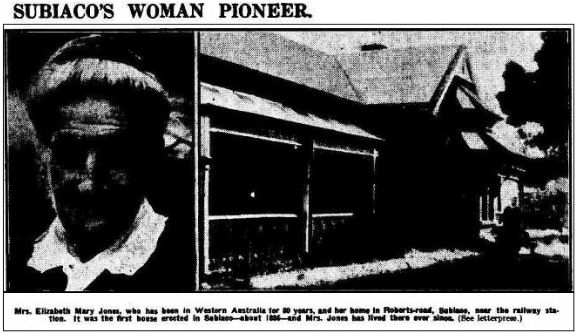
A wonderful story and photographs about one of the early pioneer women in Subiaco, Elizabeth Mary Connor published in The West Australian on 24 September 1932. 


The photograph of Mary Elizabeth Connor and her husband John Rowland Jones at their home in Roberts Road, Subiaco is from the Facebook page of the City of Subiaco. No copyright infringement intended. 


The article is copied from Trove, the database of the National Library of Australia. No copyright infringement intended, 


West Australian,  24 September 1932.


PIONEER OF SUBIACO.


MRS. JONES'S MEMORIES. 


First House in the Suburb.


On April 28, 1853 the barque Palestine dropped anchor in Gage Roads, Fremantle. The vessel had taken six months to make the voyage from England to Fremantle.


Among the passengers who went ashore was Elizabeth Mary Connor, then barely three years of age, a native of Cornwall, who had made the trip with her parents. The child grew up in the colony and later married Mr. J. Rowland Jones, short-hand reporter and journalist, and went to live in the first house built in Subiaco, now 365 Roberts-road, Subiaco, about 20 chains east of the railway station. She lives there still. 


In the sitting-room of this house yesterday, Mrs. Jones recalled her long life in Western Australia. Often the corners of her mouth would wrinkle in a smile, and her keen eyes would twinkle, as she wove a humorous thread into the fabric of her story. 


There was enough and to spare of work, sorrow and fun in the life of the early settlers. Elizabeth Mary Connor first lived with her parents in a little cottage in front of the Perth railway station. The Globe Hotel now probably stands on the site of the old cottage. From that house they shifted to a cottage at the bottom of Mill-street, near Lefroy's garden, on which Winterbottom's Garage 'now stands. Later the Connor family went to live in Mount's Bay-road. 


Mrs. Jones's father went to Victoria in a gold rush. He sent her mother sums of money, and expressed his intention of making a home for his family, but he was never heard of again. Mrs. Jones's mother married a second time. Elizabeth Mary's stepfather was in charge of one of the "Puffing Billies" on the river.


“Puffing Billy." 


This "Puffing Billy" was used to take stores up and down the river. When the Fremantle bridge was being built, timber was taken from the upper reaches of the Swan River at Guildford to the port. Comparatively small lengths of timber were stacked on the deck of the small craft and one or two piles, according to size, were chained on each side of the vessel. 


The old bridge, later superseded by the present Causeway, was frequently under water in the winter months. Mrs. Jones and her sisters often went down to see the new Causeway being built. A barge was provided for taking horses and carts across the river during the winter. After being educated at the Convent of Mercy, in what is now Victoria-square, Mrs. Jones undertook dressmaking. She made dresses for the ladies of many of the old families. The Misses Leake were among her clients. When the third daughter of the Leake's became Lady Parker, the wedding dress was the work of Miss Elizabeth Mary Connor. The wife of Bishop Parry, who before her marriage was a Miss Leake. was another of Miss Connor's clients, among whom were the Burts and the Roes, and many other families. 


When she was 23 years of age Miss Connor was married in St. Mary's Cathedral to Mr. J. Rowland Jones. Father O'Reilly, who later became Roman Catholic Archbishop of Adelaide, celebrated the marriage, and Mr. John Whitely, who was subsequently Commissioner of Taxation in Western Australia, was the best man. In the early days of the colony. Mr. Jones was employed as a shorthand writer to the Legislative Council. With the establishment of Responsible Government he became shorthand writer to the Legislative Assembly. For a time Mr. Jones was editor of the "Western Australian Times," which was later merged with the "Perth Gazette" and became '"he West Australian." There was little money in the colony in the early days and the workmen had to take orders upon storekeepers as wages. The storekeeper supplied the man's needs and gave him cash to pay his butcher and other tradesmen. 


About 1886 Mr. and Mrs. Jones decided to build a residence about three miles west of Perth at a spot on the opposite side of the railway line to the Benedictine monastery. Before the house could be constructed, water was essential. Steps were taken to sink a well. The "experts" said water would be found at 18 feet. Bricks were scarce and orders had to be placed with the brickmakers at Guildford a long time ahead. Bricks sufficient to line a well to a depth of 24 feet were obtained. At 24 feet there was no sign of water. Another order for bricks was given, again on the advice of the "experts." But again water was not located. It was only when the well had been sunk to a depth of about 60 feet that water was obtained, and the construction of the house could be begun. The well took nine months to sink. 


Camel Teams from Fremantle. 


A railway platform had been constructed almost immediately in front of the house, which now stands in Roberts-road, Subiaco. The platform was about 20 chains east of the present railway station. There were three or four trains a day between Perth and Fremantle when Mr. and Mrs. Jones went to Subiaco to live. After leaving Perth, the only other buildings near the railway line were a few houses in Colin street, and a house and woodyard near the Leederville station. Camel teams journeying from Fremantle to the goldfields frequently passed the lone house at Subiaco. 


Before Broom-road (Hay-street) was extended to Subiaco it was not unusual for Mr. and Mrs. Jones in their cart to take the wrong track and become temporarily lost in the bush. When Mr. Jones was working on the "Western Australian Times" and on Hansard, a light was left burning behind a window of the Jones's homestead to guide him home. At night the train stopped at the little platform when a match was struck or a lighted lamp was held aloft. Mr. Jones died in 1895.


Mrs. Jones has many treasures. They include old documents, a copy of the jubilee issue of the "Western Australian Times," edited by her husband, and other papers, an old prayer book which belonged to her father, and which is over 200 years old. She sets great store by two needlework pictures which were brought to the colony by her mother. The pictures, exquisitely worked, are claimed to be over 300 years old. On the voyage to Australia the captain of the barque offered Mrs. Connor £5 each for the pictures. "If they are worth £5 to you," she replied, "they are worth £5 to me." 


On Wednesday Mrs. Jones journeyed to Fremantle to welcome a son home from Singapore. She has nine children, 19 grand-children and one great-grandchild. On May 31 last she celebrated her 83rd birth-day. Time does not hang heavily on her hands. "A little sewing and reading,"' was how the "mother" of Subiaco described her interests.


Wednesday, 8 March 2023

Woman's History Month...2023. Post 8... My Great Grandmother's House...100 Blog Posts.

Woman's History Month...2023. Post 8... My Great Grandmother's House...100 Blog Posts.

This month is Women's History Month. I have decided to repost the stories of many of the wonderful women from Subiaco I have come across. 

While this is not about a woman from Subiaco these articles were a special find on Trove. 

My Great Grandmother's House...100 Blog Posts.

I never knew my great grandmother or grandfather. I did not know my grandmother who died in 1952. My grandfather died in 1973 when I was 10 years old. I learnt a little bit about my mother's side of the family and where they were from over the years through stories told to me by my mother and a collection of photographs. 

My interest in family history started when I found my grandmother's death notice on Trove, the database at the National Library of Australia. It was very emotional reading the notice. When I did a basic search of my grandmother's maiden name I found a collection of articles from a variety of sources. There were a number of articles collected via a brother who served in World War One in a Lighthorse Brigade created from documents from the Australian War Memorial and National Archives. There were articles about a sister who married a man who later became a mayor of East Fremantle.

Many of the documents about the history of the Wheelock family were collected for a page about a soldier in World War Two named Jack Logan Wheelock, the son of Darcy Logan Wheelock and Enda Elizabeth Wheelock (nee ILes) called 'WX8753 Wheelock Jack Logan - 2/4 Machine Gun Battalion'.

An entry from Friends of the Battye Library...

"WHEELOCK, CHARLES THOMAS, b. Toodyay, d. 15-5-1916, m 16.6.1885 (Carnarvon) Jessie Nevin McJANNET. Chd May Elizabeth Wheelock b. 1886 d. 1964 (Carnarvon owned drapery store), Darcy, Gerald d. 1964. Shepard at Irwin, drover of flocks into Gascoyne district. In partnership with G.J. Gooch, established "Wandagee Station" 1880. Was at meeting there when 1st Gascoyne Rd. Bd. was formed 1882. To Carnarvon, built "Red House" 1883. Town councillor employee as well as station manager, town butcher. Pesbyt..."     

The highlight of my search came when I searched the Royal Historical Society of Western Australia collection of digitalised photographs. I found a photograph titled 'Cotton Palm At Site of Red House Carnarvon'. The summary read "Cotton palm at site of Red House. Carnarvon. Note 'May Wheelock's birthplace and her mother's treasured cotton palm in a week enshrouded garden on the banks of Gascoyne River, Carnarvon. The cotton palm was grown and cared for by Mrs. C. Wheelock who built the Red House in the background. The wheels etc are all that remain of early transport". The photograph was by R. Scott-Memory.

There is also a photograph of May Elizabeth Wheelock. The summary of the photograph reads "In front of the home her father built in 1884 - Red House at Yankee Town on the Gascoyne River. Carnarvon. Verandahs were added later." The photographer was R. Scott-Memory. 

There is a considerable amount of information about their family home the Red House. The Red House is a heritage listed building on the Inherit State Heritage database. 

"...History

The Red House was built around 1883 in what was known as Yankee Town about three miles from the town centre. It was built by Charles Wheelock for his bride to be Jessie Nevin McJannet whom he married in 1885. They had six girls and two boys, the first child being the third white child to be born in Carnarvon. Their child May Elizabeth born in 1886 lived for seventy eight years in Carnarvon. Bricks were handmade mud bricks from the red soil. The house was renovated by Ann and Mike Kerswill and a portion of the mud brick section was left for tourists and interested people to see. The Cotton Palm is almost as old as the house having been planted by the Wheelocks from a seedling brought home in Charles Wheelock’s saddle bag from a droving trip and nurtured through drought seasons by Jesse. At one time, Aboriginal mothers and children used to hide and sleep under the beds in the Red House for fear of the ‘Gum mint’ (government) Man coming to get them (a law at that time was to separate the Aboriginal children from their mothers). The Red House is one of the few remaining homesteads and has stood for over 100 years through cyclones, floods and droughts and should continue to do so for much longer.

Physical Description

A hipped roofed dwelling with a surrounding partly enclosed verandah. The bricks used in the construction of the house were hand made locally. The original owners were the Wheelocks..."

The dream is to go up to Carnarvon and visit the house. Writing family history is very emotional. While I have learnt a lot from those who have kept records and photographs of the past  there is still a long way to on this journey. 

The photograph below is from the Royal Historical Society of Western Australia. The photograph below is from the Inherit database. No copyright infringement intended. 


Stories From The Perth Children's Hospital (1930 - 1950).

Stories From The Perth Children's Hospital (1930 - 1950). The Perth Children's Hospital was built in 1909 on the corner of Hay and T...