Sunday, 8 May 2022

Some Mother Stories From Subiaco... (1940's and 1950's).

Some Mother Stories From Subiaco... (1940's and 1950's).

The following two stories from Subiaco about mothers and their children were published in newspapers during the 1940's and 1950's. I will just let the stories speak for themselves without judgement.  

The articles and photographs are from Trove, the database of National Library of Australia. No copyright infringement intend.   


Sunday Times, 3 May 1953.

Helps Son Sell Papers

You could describe her as an inspiring example of mother devotion Mrs. Annie O'Brien and her son.

For years she has helped her incapacitated son to sell his newspapers. Next Sunday is Mother's Day.

So let's introduce you to 71-y-o Mrs. Annie O'Brien.

We snapped her yesterday selling papers on an hotel corner in Subiaco to assist her deaf and dumb son.

Each afternoon the old lady travels from Park-street, Subiaco, to the corner of Hay-street. and Rokeby-road to help son Norman Charles, 41, (well-known in the district) who has a stand there.

She receives no pay.

Close pals, the two live together and mother has tended son deaf, dumb and crippled since birth.


Daily News, 18 July 1946.

Deserted By Her Young Mother. 

Margaret Rose, (picture above) is a brown-eyed, vivacious little girl who was left at St. Vincent's Foundling Home Subiaco, when she was 12 days old. She is two now, but her mother has not called for her. 

Her mother was a 17-year-old girl when she first asked the Sisters of Mercy for help. They received her there, cared for her six months before her baby was born. When, she left hospital, she was welcomed back to the home and her baby was accepted in the nursery.

Later, the home found her a good job. At first it was thought that Margaret Rose could be adopted and go to a good home where a couple who loved babies would welcome her. But it was discovered that she was not suitable for adoption. 

Since her mother deserted her, St. Vincent's Foundling Home has been entirely responsible for her. No one pays for Margaret Rose. Her mother did promise to pay  something for her keep, but it was only a promise. 

Now the child is old enough to leave the nursery, she is in the toddlers' home, attends the home kindergarten every morning. Although her relatives have been asked, to come to see her, they do not show any interest, do not visit her. 

But she won't lack love and care. St Vincent's Foundling Home and St Joseph's Orphanage will care for her until she is educated and trained to work according to her own wish. 

Tomorrow, St Joseph's Orphanage and St Vincent's Foundling Home, Subiaco, will, for the first time in their history, appeal to the public in city, streets.


Saturday, 7 May 2022

The Lipfert Sisters...

The Lipfert Sisters...

This blog post is a continuation of the previous blog post "Alexandra McKinnon Burns... Subiaco Business Woman (1938)" about the women mentioned in the Museum of Subiaco exhibition on International Women's Day. This post is about sisters Maria, Olga and Elsa Lipfert.

The following information is from the previous blog post..."During March International Women's Day was held. The Subiaco Museum created an exhibition to highlight the contribution of women to the Subiaco community. 

The women included Alexandra McKinnon Burns (1864 -1961), Dame Annie Florence Gillies Cardell-Oliver (1876 - 1965), Adelaide 'Queenie' Chugg (1898 - 1981), The Lipfert Sisters (Minna Maria Lipfert (1902 – 1959), Olga Gertrude Lipfert (1906 - 1989) and Thekla Elsa Lipfert (1912 - 1989) and Ethel Maude Thomas M.B.E (1881 - 1961). The exhibition contained a number of wonderful photographs and artefacts and is available on the webpage from the Subiaco Museum.

While there is a substantial amount of information about the exceptional work and life of Dame Cardell-Oliver available on various sites on the Internet, Trove, the database of the National Library of Australia contains some wonderful information and photographs about the women mentioned by the Subiaco Museum in their exhibition..." 

Herman Franz Otto Lipfert was born at Poessneek, Saxe Meiningen, Germany, in 1864. Otto arrived in Western Australia at the end of 1892 and began work at the Western Museum in 1894. He married Anna Maria Franiska Struck in 1902. Together they had four children Minna, Olga, Elsa and Heinrick. The family lived at 270 York Street, Subiaco. 

The following information about the Lipfert sisters is from the Subiaco Museum's webpage on International Women's Day about the Lipfert Sisters. 

"...Minna, Elsa and Gertrude were the three daughters of the WA Museums famed taxidermist, Otto Lipfert and his wife Anna. The family lived at 270 York Street, Subiaco and the daughters attended the Subiaco Infants School and Subiaco State School. 

Minna was a teacher at Rosalie Primary School for 31 years. A memorial plaque to Miss Lipfert was unveiled in August 1959 at the school in the centre of a grove of trees.

Gertrude attended the School of Domestic Arts and became a dressmaker and professional embroiderer.  Many of her samplers and embroidery work are currently on display in the museum’s 'A Woman's Work; Dressmaking and Handcrafts in Subiaco’ exhibition.

Elsa attended Perth Technical School and received her Commercial Junior Certificate in 1927 from UWA. She went on to work as a private secretary to the Crown Law department.

All three daughters never married and much of their remaining household goods were donated to the museum and form the Lipfert collection..." 

There is a substantial amount of articles and photographs about the Lipfert family in the State Library of Western Australia. Ken Spillman who wrote a book about the history of Subiaco "Identity Prized: A History of Subiaco" in 1986 completed oral histories with Elsa and Gertrude Lipfert about their life in Subiaco.  

Trove, the database of the National Library of Australia contains many articles and photographs about Otto Lipfert and his work with the Western Australian Museum published in newspapers. 

The photographs are from the State Library of Western Australia. No copyright infringement intended. 


Otto Lipfert's children - from left: Heinrich, Maria (holding book), Olga and Elsa (seated), ca. 1914.


Family of Otto Lipfert, ca. 1910.

Tuesday, 3 May 2022

Alice Burns...A Subiaco Woman's Charity Work (1936).

Alice Burns...A Subiaco Woman's Charity Work (1936).

Alice Burns did a substantial amount of charity work for the local Subiaco community in the 1930's. As there were a number of women who identified as Mrs. R. Burns, the address 178 Barker Road was used in newspaper articles to distinguish her from other women with the same name. 

Alice Burns was married to Robert Williams Burns. Robert was a financier and jeweller who had a shop at 82 Rokeby Road, Subiaco. Their private residence was 178 Barker Road, Subiaco. They do not appear to have had any children. 

The charity work done by Alice Burns included providing money to buy clothing during winter for children, for 100 children of unemployed men to visit the circus and advocating for the free milk program in state schools and the homes of unemployed men with children. Her work was recognised in a letter by Mr. A. C. Higgs, secretary of the Subiaco Unemployment Relief Committee to the Subiaco Municipal Council published in the Daily News newspaper on 26 January, 1936. The letter is copied below. 

William Burns died  on 14 December 1934. Alice Burns died on 12 November 1940. 

The articles are from Trove, the database of the National Library of Australia. No copyright infringement intended. 


West Australian, 18 September 1933.

CHILDREN'S CIRCUS TREAT.

A rare treat was given to 100 children of unemployed men at Subiaco on Thursday by Mrs. R. W. Burns, of 178 Barker-road. Subiaco who paid for their admission to Wirth's Circus, and for their transport by special tram from Subiaco and back, as well as providing each child with a bag of sweets. A selection of the children was made by the honorary secretary of the Subiaco unemployment relief committee (the chief health inspector, Mr. A C. Higgs), with the assistance of the head mistress of the infant school at Subiaco (Miss Lutz). The children's enjoyment of the unexpected treat was plainly shown, and an expression of gratitude from parents has been received at the office of 'The West Australian.'

Daily News, 27 January 1936.

SUBIACO WOMAN'S CHARITY IS APPRECIATED

References to the charitable work of a woman resident of Subiaco are contained in a letter forwarded to Subiaco Municipal Council recently by Mr. A. C. Higgs, secretary of the Subiaco Unemployment Relief Committee. The letter tells its own story and reads:- 

"As secretary of the Subiaco Unemployment Relief Committee, I desire to bring under the notice of the Mayor and councillors, the excellent service rendered in the municipality by Mrs. R Burns, of 187 Barker-road. From the time the Unemployment Relief Committee came into being in the year 1930, Mrs. Burns has contributed very generously, especially where children would benefit. It would appear that needy children incite her sympathies every winter season. On several occasions she has donated large sums of money to purchase blankets and warm clothes for children. "

"This year (1935) her generosity has been outstanding. Early in the month of June she inquired from me the position of the children of families whose income was meagre. She was anxious that the children would receive the benefits personally and directly. I was able to inform her that there were many children attending school whose parents could not afford to let them get the benefits of the daily bottle of fresh milk during school hours, and after consultation with head teachers at four schools Mrs. Burns instructed me on her behalf to expend £1 per week in providing warm milk and, where necessary, clothes and shoes for children whose parents could not afford it. The scheme was commenced on June 14, and terminated on December 20, a period of 27 weeks, involving an expenditure of £27." 

"The results were excellent. Teachers and parents were agreeably surprised at the physical and mental progress made by the children as a result of the daily supply of milk. In fact one head teacher informed me that prior to the distribution, a number of the children showed definite signs of fatigue near the end of the morning or afternoon session, and their studies were hampered as a result, but soon after having the milk a marked difference was noticeable. Her generosity also permitted some children to sit in comfort in school because of having been provided with warm boots and stockings. Many individual cases of development were noted."

Sunday Times, 26 January 1936.

WHOLE MILK ACT THE BOARD'S PROPOSALS

A More Liberal Consumption

Aimed At

Mr. A. C. Higgs, Chief Health Inspector of the Subiaco Municipal Council, writes as follows:

"In explaining the amended provisions of the Metropolitan Whole Milk Act 1932, Mr. Wilson, chairman of the Metropolitan Milk Board, recently indicated his intention to do those things calculated to increase the sale of fresh milk. He is to be highly recommended and should receive the support of all who can assist.

"In my official capacity and also in the capacity of hon. secretary of the Subiaco Unemployment Relief Committee and also hon. secretary of the Infant Health Association, I have had opportunity , of observing how necessary it is for more fresh milk to be included in the diet of a large number of people, especially mothers of infants and children, and how remarkable it is that when people, axe forced to economise in household management that almost the first article to be eliminated is fresh milk.

"Mr. Wilson's plans will prove to be a boost if the people's attention is focussed on the fact that milk is a lifegiving food, and that their health and vigor can be improved and maintained in an improved condition by a more liberal - consumption of fresh milk, and that instead of minimising the quantity of the daily family supply it should be increased in times of adversity and other less nutritive articles of diet eliminated.

"It is to be hoped that every agency and every association which has the health of the community at heart will put the full weight of their influence behind the efforts of the Milk Board to increase the consumption of fresh milk. People in a private capacity may also help, if their help is guided through the right channels.

"Let me quote an example in Subiaco:

"Mrs. R. Burns, of 178 Barker-road, who is continually doing acts of kindliness, especially among children, called on me one day; and discussed the obvious malnutrition of some of the children and how best to combat it.

"As a result of this discussion, I interviewed four head masters and mistresses of schools in the municipality and ascertained how many, children were not participating in the milk supplied to the schools, and what was the effect on the children who were not participating. I found that the parents of a large percentage were not able to find the sixpence per week necessary to give the child a bottle of milk on five days of the week, and that the child suffered, mentally and physically in comparison with the children who were receiving the milk; in fact, at one school no milk scheme was in operation.

"The result of these inquiries was that Mrs. Burns immediately authorised the expenditure of £1 per week to be distributed among the children of indigent parents. A start was made at the school where there was no milk distribution, and the worst of the cases were taken in the other three-schools, and from June 14 till the Christmas vacation, a period of 27 weeks, 40 children received a bottle of milk for five days of each week. In some cases, where a child was too ill to attend school, a bottle was sent home.

"The teachers at the schools entered  whole heartedly into the scheme, and in every class glowing reports were received of the decided improvement mentally and physically mode by most of the children who received the milk as a result of Mrs. Burns' generosity.

"By this means approximately 450 gallons of milk were consumed, with good results. Although such good results were obtained we could have done better still If more friends had contributed."


Alexandra McKinnon Burns... Subiaco Business Woman (1938).

Alexandra McKinnon Burns... Subiaco Business Woman (1938).

During March International Women's Day was held. The Subiaco Museum created an exhibition to highlight the contribution of women to the Subiaco community. 

The women included Alexandra McKinnon Burns (1864 -1961), Dame Annie Florence Gillies Cardell-Oliver (1876 - 1965), Adelaide 'Queenie' Chugg (1898 - 1981), The Lipfert Sisters (Minna Maria Lipfert (1902 – 1959), Olga Gertrude Lipfert (1906 - 1989) and Thekla Elsa Lipfert (1912 - 1989) and Ethel Maude Thomas M.B.E (1881 - 1961). The exhibition contained a number of wonderful photographs and artefacts and are available on the webpage from the Subiaco Museum.

While there is a substantial amount of  information about the exceptional work and life of Dame Cardell-Oliver available on various sites on the Internet, Trove, the database of the National Library of Australia contains some wonderful information and photographs about the women mentioned by the Subiaco Museum in their exhibition. One of those women is Alexandra McKinnon Burns.  

Alexandra McKinnon Burns was born in 1864 in Spring Creek, Victoria. She married William Burns. After William established the Brown and Burns Bakery in Subiaco in partnership with Samuel Brown she followed him to Perth. Together they had four sons, Thomas, Ormond, Robert and Jack and a daughter Alexandra (Lexe). The family lived at 25 Catherine Street, Subiaco.  

In 1931, the Daily News newspaper published an article about how the Brown and Burns Bakery had become a quality bakery, not only in Subiaco but throughout Perth. The article discusses the products the bakery made and the methods used to make and deliver bread throughout the metropolitan area. The business employed 25 permanent employees. 

After William's death and Mr Samuel Brown entered Parliament, the partnership was dissolved. Alexandra purchased all interests in the business which she directed before including her sons and daughters in the partnership. She was the governing director until her death in 1938 (West Australian, 28 May 1938). 

In 1938 the West Australian published a detailed obituary following the death of Alexandra McKinnon Burns "...All her life Mrs. Burns was a strong adherent of the Presbyterian Church. She was devoted to her four sons and her daughter and to her grandchildren; endeared to her other relatives, of whom there are a considerable number in Western Australia and greatly appreciated by a very large circle of friends. 

In recent years Mrs. Burns made a world tour and also paid a visit to China and Japan. being accompanied on the first occasion by her daughter, now Mrs. van der Sluys of New Guinea. Mrs. Burns was also an ardent supporter and worker for the Y.A.L (Young Australia League...." (West Australian, 26 May 1938).

The articles and photographs are from Trove, the database at the National Library of Australia. No copyright infringement intended. 

The photograph of Alexandra McKinnon Burns is from the Museum of Subiaco webpage. No copyright infringement intended.


Daily News, 18 March 1931.

SUPREMACY IN BREAD-MAKING.

Bread, which has been man's first necessity throughout all the ages, has undergone changes at various times, but the basic conception remains . Bread presenting in this form the incomparable nutrition that is derived from the grain. After all the bread fads which have, come and gone in recent times it is refreshing to find that in Subiaco the old and reputable firm of Messrs. Brown and Burns Ltd., in Hay street, prefer to adhere to the original idea with the difference - that they are for ever seeking to improve upon the methods by which good, simple, plain bread is made. 

Not only in Subiaco but every part of Perth the mention of the name of Brown and Burns is synchronised to the picture of the perfect loaf. The firm dates its history back to 1897, when Subiaco would have provided excellent location if there had at that time been a motion picture company producing scenes in Sahara. The original members of the firm were the late Samuel Brown and William Burns. From the smallest kind of bakery the business has grown to the large and commodious premises in Hay-street, which are grown throughout the entire metropolitan area. From delivering the bread in a basket to the present splendid motor-van service pictured on this page some idea may be gained of the progress which has been made. 

Mr. T. A. Burns tells us that they have followed every development in breadmaking in recent years, but although they make fancy breads they believe that nothing is produced today that is superior to the Vienna loaf or rolls, in which they specialise. This is a highly riur tritive bread made of milk, butter and sugar, and is baked in a special oven known as a steam tube, made for the purpose. Among otter up-to-date devices used by the firm are two types of dough mixers, dividing and weighing machines and other forms of mechanism designed for, convenience, hygiene and greater efficiency in baking. 

The extent of the business of Messrs. Brown and Burns may be gauged by the fact that they bake about one million loaves of bread annually and that their custom extends all over, the metropolitan area. They have 25 permanent employes. Their products and Particularly their Vienna rolls are served in most of the tearooms in Perth. The firm are also famous for their Health and Veeda breads, which are unexcelled in food value. Messrs. Brown and Burns Ltd. Bakery.

West Australian, 26 May 1938.

The Late Mrs. A. McK. Burns. 

The funeral of the late Mrs. Alexandra McKinnon Burns. of 25 Catherine-street, Subi #aco. took place in the Presbyterian Cemetery, Karrakatta yesterday afternoon in the presence of a very large and representative gathering. 

The service at the graveside was conducted by the Rev. T. P. MeEvoy, of the Subiaco Presbyterian Church who during the course of an eloquent tribute to the life of the late Mrs. Burns, referred to her devotion and adherence to her principles. Mrs. Burns was the sixth daughter of Mr. and Mrs. LackIan McKinnon. who went from the Isle of Skye to Victoria in 1852. 

She was born at Spring Creek near Daylesford, and close to the famous Hepburn Spa, in 1864. After her marriage to Mr. William Burns in the late eighties she resided in Melbourne until she followed her husband to Perth in 1897, shortly after he had, in partnership with the late Mr. S. Mc. Brown. established the bakery establishment of Brown and Burns at Subiaco. 

Since then she resided in that suburb of Perth. Her husband predeceased her 34 years all but a day. After Mr. Brown had entered Parliament the partnership was dissolved. Mrs. Burns purchasing all interests in the business which she directed with considerable acumen for a long period before she took her sons and daughter into partnership. She remained governing director until her death, the management being in the hands of her eldest son. Mr. T. A. Burns, who, until recently, was president of the Master Bakers' Association of this State and, for a term, was Australasian President of the master bakers' organisatlons. 

All her life Mrs. Burns was a strong adherent of the Presbyterian Church. She was devoted to her four sons and her daughter and to her grandchildren; endeared to her other relatives, of whom there are a considerable number in Western Australia and greatly appreclated by a very large circle of friends. 

In recent years Mrs. Burns made a world tour and also paid a visit to China and Japan. being accompanied on the first occasion by her daughter, now Mrs. van der Sluys of New Guinea. Mrs. Burns was also an ardent supporter and worker for the Y.A.L. 

The chief mourners were Messrs. T. A.. O. A., R. W. and J. H. Burns (sons). Mrs. J. van der Slurs (daughter). Mrs. M. Roe (sister), Mr. J. Burns (brother-in-law)....


Thursday, 28 April 2022

Subiaco Women And Baking Recipes...(1916).

Subiaco Women And Baking Recipes...(1916). 

There was such a great response to the previous posts about the recipes published in newspapers from the women of Subiaco in the early years of the colony more have been included, this time from 1916. This blog post contains recipes from the women of Subiaco for recipes for baking including cakes, scones, biscuits and desserts.      

In 1916, The Sunday Times continued to run their recipe (but had limited their household hints competition) offering prizes each week to women (and men) readers who shared their recipes and household hints. The entry coupon with the prizes for 1916 is copied below. 

During 1916 there were nearly 80 recipes from the women (and men) of Subiaco that won prizes and received honourable mentions that were published during the year. They shared recipes for meat, puddings, cakes, preserves and sauces, vegetarian dishes and international dishes for example curries that began to appear. The women of Western Australia and Subiaco showed to be creative cooks and homemakers sharing a variety of recipes and household hints.      

By 1916 World War One had been declared and was in its second year. Australian men and women were volunteering for the services and leaving to go overseas. There were food shortages as food was redirected to troops and labour shortages. Women experienced rationing at home and were encouraged to be self sufficient and have chickens and grow fruit trees and vegetables in the backyard.  

The traditional spelling and grammar found in the published recipe has been maintained. 

The articles and photographs are from Trove the databased of the National Library of Australia. No copyright infringement intended. 


The Sunday Times, 30 January 1916.

Second Prize.

Second prize is awarded to Mrs. C. Wilkinson, 13 Denis-street, Subiaco, for recipe for - 

DATE CAKE.

Take the weight of two eggs in butter, sugar and flour, and 2 oz. of dates. Cream the butter and sugar and add the eggs, and then the flour. Place the mixture in a flat tin, and stone about a dozen dates, inserting an almond instead of the stone. Place them in rows in the mixture and bake for ten to fifteen minutes. When cold ice the top and cut into finger shapes. 

Honorable Mention.

Cocoanut Cheesecakes. - Line tins with good pastry; three-parts fill with following mixture: - Beat two eggs lightly, place in a jar with an ounce of butter, 1/4 lb. of caster sugar, 3 oz of cocoanut, and a little grated lemon rind. Stand jar in a saucepan of boiling water over the fire, and stir until it thickens. Back unitl a pale fawn color for about 15 minutes. - Mrs T. Ellis, 37 Lawler-street, Subiaco. 

The Sunday Times, 23 January 1916.

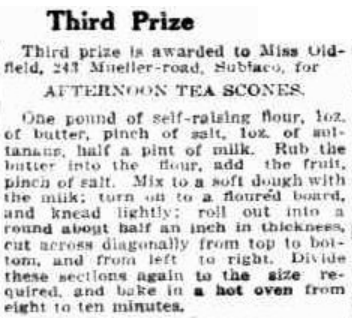
Third Prize.

Third prize is awarded to Miss Oldfield, 243 Mueller-road, Subiaco, for

AFTERNOON TEA SCONES.

One pound of self-raising flour, 1 oz. of butter, pinch of salt, 1 oz. of sultanans, half a pint of milk. Rub the butter into the flour, add the fruit, pinch of salt. Mix to a soft dough with the milk; turn on to a floured board, and knead lightly; roll out into a round about half an inch in thickness, cut across diagonally from top to bottom, and from left to right. Divide these sections again to the size, required, and bake in a hot oven from eight to ten minutes.

Honorable Mention.

Cake Trifle. - Cut the inner part out of a spongecake, leaving a wall and floor about 2 in. Fill the hollow with custard, sprinkle with blanched and split almonds, and dot with heaps, of red currant jelly. Beat up the whites of two eggs with sugar and little flavoring of vanilla, and pour over the trifle. - Miss A Powell, 173 Railway-road, Subiaco

The Sunday Times, 27 February 1916.

First Prize. 

First prize is awarded to Mrs. M. Harding, 220 Barker-road, Subiaco, for recipe for

PASSION-FRUIT CAKE.

Take one dozen passion-fruit, 1/4 lb. butter, 1/2 lb. flour, 1/4 lb. sugar, two eggs, and one teaspoonful of baking powder. Open the passion fruit, put the pulp on a hair sieve with a little sugar, rub it through; beat the butter and sugar to a cream, drop in the eggs, and when well mixed pour in the juice of the passion fruit. Beat the flour and baking powder in with a spoon. Line two sandwich tins with buttered paper, divide the mixture, and pour it in; bake in a moderate oven for about half an hour. When cold spread the following mixture in between the layers; beat the white of one egg to a froth, add 3/4 lb. powdered sugar and the juice of two passionfruits. Spread the jelly on the cakes, and lay one above another. Spread the top of the cake either with whipped cream or white icing.

The Sunday Times, 5 March 1916.

Honorable Mention. 

Apple Gateau. -  Cover the bottom and sides of a Yorkshire pudding tin to the level of an inch with shortpaste, fill it with apples stewed, sweetened, and beaten smooth. Across the top form a diamond pattern with twisted narrow strips of paste. When nearly baked, brush over with sugar dissolved in a few drops of water. Boil the cores and parings of the apples in a little water, strain, then boil again with two tablespoonfuls of apricot jam or apple jelly, and when cool fill the diamond-shaped cavities with it. - Mrs. F. Truelove, 20 Morgan-street, West Subiaco.

The Sunday Times, 19 March 1916.

Recipe Supplied.

Victoria Sandwich. - Ingredients: Take two breakfast cups of flour, one teaspoonful cream of tartar, half teaspoonful carbonate soda, one cup sugar and three eggs, a little milk. Mode: Beat the whites and the yolks of eggs separately. When well beaten, mis together, adding the sugar and milk, then slowly pour into the dry ingredients, stirring till smooth. Bake in two sandwich tins in a moderate oven for 15 or 20 minutes. A delicious cream filling is made as follows: Two teaspoonfuls of butter and enough icing sugar beaten together to a stiff consistency and flavored with a few drops of lemon essence. - Miss Muriel Reid, 441 Rokeby-road, Subiaco.

The Sunday Times, 11 June 1916.

Honorable Mention.

Sandwich with Passion-Fruit Filling. -Beat three eggs and one breakfast cupful sugar for ten minutes, and then add one breakfast cupful flour. Butter sandwich tins, pour in mixture and bake in a hot oven. Filling: One white of an egg, juice of three passion fruit, 3 lb. icing sugar. Whip the white of egg on a large dinner plate, using a broad-bladed knife. Roll and sift the icing sugar, add it to the white of egg, gradually beating while adding, then stir in the passion fruit juice. This is then ready for filling the sandwich and icing the top. - Mrs. M. Harding, 220 Barker-road, Subiaco.

The Sunday Times, 6 August, 1916.

Honorable Mention.

Baked Batter Pudding. - One pint of milk, 2 oz. butter, 4 eggs, and a little salt. Method: Mix the flour with a small quantity of cold milk, make the remainder hot, and pour it on the flour, keeping the mixture well stirred; add butter, eggs and salt; beat the whole well, and then put the pudding into a buttered piedish. Bake three-quarters of an hour, and serve with sweet sauce, wine sauce, or stewed fruit. Baked in small cups, this makes very pretty little puddings. - M. Moore, 10 Campbell-street Subiaco.

Sunday Times, 17 September 1916.

First Prize.

First prize is awarded to Jean McPhee, 31 Railway-road, Subiaco, for recipe

PRESBURG WINE FINGERS.

Ingredients: Three-quarters of a pound of flour, 1/2lb. sugar, 1/2lb. butter, two eggs, half-gill of sherry and brandy mixed, ground cinnamon, chopped almonds, sugar, a pinch of salt. Mode: Beat the sugar and butter to a cream, add the yolks of eggs, the wine and brandy, then mix in the flour. Roll out about 1/2 in. thick, keeping it as square as possible; trim off any rough edges. Brush all over with the beaten white of egg; sprinkle thickly with the cinnamon, sugar and chopped almonds; press them down with the rolling pin to make them a little firm; then cut the sheet into strips about an inch wide; cut these into finger lengths, and put on a baking sheet. Bake in a very moderate oven for about half an hour, or until they are a light brown color.

The Sunday Times,  24 September, 1916.

Honourable Mention.

Cocoanut Biscuits. - Required: A small tin of good condensed milk, 1/2 lb. of fine desiccated cocoanut, rice paper. Method: Pour the milk on the cocoanut and mix well together, then put a 1 dessertspoonful at a time on the rice paper and bake in a moderate oven. The oven should not be very hot or the biscuits will easily burn. They should be baked until they are just tinted. - Miss D. Spooner, 109 Churchill-avenue, Subiaco.

The Sunday Times, 22 October, 1916.

Honorable Mention.

Sponge Sandwich.- Ingredients: 6 oz. butter, 6 oz. sugar, 4 eggs, 6 oz. flour, 3 level teaspoonfuls of baking powder, a pinch of salt, and a little essence of lemon. Beat butter and sugar for ten minutes to a cream, and add a pinch of salt. Method: Beat eggs well with essence, then add to sugar and butter. Sift in flour and baking powder, mix thoroughly, put in sandwich tins, and bake in moderate oven for twenty minutes. Filling for sandwich: Mix one tablespoonful of butter and enough icing sugar to make a nice cream, essence vanilla to taste, and cochineal to color a nice pink. Spread between sandwich, and put a little on top and sprinkle with cocoanut. - Mrs. M. Harding, 220 Barker-road, Subiaco.

The Sunday Times, 17 December, 1916.

Honourable Mention.

Cream Potts.- Ingredients: One cup water, one cup plain flour, four eggs, 4 oz. butter. Mode: Boil water and butter together. When boiling sift flour in and stir well: when done will come off pot clean; let cool; beat eggs, one at a time, into mixture; put in spoonfuls on buttered paper. Bake in moderate oven 20 minutes to half an hour.- G. M. Ray, c/o Post Office - Subiaco. 

The Sunday Times, 31 December, 1916.

Honourable Mentions.

Parkin. Take two cupfuls plain flour, two teaspoonfuls baking powder, one cupful (small) of sugar, one cup of treacle, half cup of milk, 1/2 lb. of lard, 1/2 lb butter, two eggs mixed slade Bake one hour in a slow oven. Miss Oldfield, 243 Roberts-road, Subiaco.

The photograph of Six Cakes from One Recipe is from The Sunday Times, 23 May 1926. 


Monday, 25 April 2022

Remembering Darcy And Jack Wheelock...(ANZAC DAY 2022).

Remembering Darcy And Jack Wheelock...(ANZAC DAY 2022).

Today is the 25 April and one of the most important days on the Australian calendar in which we pay tribute to those men and women, past and present who served or serve in the armed forces. 

As the sun is rising in the east the 'Last Post' can be heard playing in Subiaco. It is on this day in 1915 that the Australian and New Zealand troops off the coast of Turkey were getting ready to storm the beaches of Gallipoli. Thousands of men died and were wounded in this campaign and today we remember them.   

Darcy Logan Wheelock was my grandmother Annie's brother. Their mother Jessie and father Charles were my great grandmother and grandfather. The Wheelock family tree was one of the first blog posts on this blog. I never met Darcy Wheelock or any of his family including my grandmother who died before I was born. Darcy Wheelock enlisted and served in both World War One and World War Two. Jack Wheelock enlisted and served in World War Two.  

Darcy Wheelock was born in 1888 in Carnarvon. Darcy Wheelock and Edna Elizabeth Iles married in 1917. Jack was born in 1919. Ronald Henry was born 1921 and later Nevin was born 1923 and Betty. Darcy's occupation was on his World War One records was listed as a teamster.

Darcy Logan Wheelock like so many young men served in World War One was in the 10 th Light Horse Regiment.  The following information about Darcy Logan Wheelock was on the AIF Project site.  

(https://www.nbradley.id.au/Martin-o/exhibits/wheelock-dl-20734.pdf )

At the National Archives of Australia the war service files available online provide wonderful information about the person, a physical description, where they trained and served and the medals they were awarded. 

The 2/4 Machine Gun Battalion webpage (https://2nd4thmgb.com.au/soldier/wx8753/) provides a wonderful collection of information from newspapers about the Wheelock family from Carnarvon, and Darcy Wheelock's son Jack who served in World War Two. This site as it provides some wonderful articles from Trove, the database of the National Library of Australia. 

This webpage writes about Darcy Logan Wheelock "...Darcy had returned home from WW1 about March 1917. He had several years earlier on 21 October 1914, enlisted at Carnarvon aged 25 years, with 10th Light Horse, 1st Reinforcement. His occupation was teamster. Darcy embarked ex Fremantle on 17 February 1915.

While Darcy was away at war his father Charles Thomas Wheelock who was born at Toodyay, died on 5 May 1916.  Darcy’s mother and Jack’s grandmother Jessie Nevin McJanet who was born 1864 Burr, Victoria married Charles Wheelock at Carnarvon 16 June 1885. Jessie Wheelock died 30 years later on 3 July 1946 at Carnarvon..."

Darcy enlisted again 11 May 1942 at Carnarvon for WW2. W82129 Darcy was located at the General Details Depot..."

"...Jack and his brothers, were talented sportsmen throughout their younger lives in Carnarvon. Jack did very well at rifle shooting, football, cycling, swimming and cricket. It seems there was no sport he was not able to participate well. From working at Carnarvon Newspapers, Jack moved south to Perth before taking up a position at Norseman...

He was able to return to cricket after the war, representing WA Newspapers where he worked. In his earlier days Jack was employed at the Carnarvon newspapers, and trained as a printer. He enlisted October 1940. He soon after joined 2/4th MGB, ‘B’ Company. He was part of the successful Army Football team, and probably the cricket team whilst at Northam..."

Jack Wheelock enlisted in World War Two on 23 October 1940 and was allocated the rank of Private. He was with the WX8753 Regiment 'B' Company. In 1943 Jack was reported missing and spent time in prisoner of war camps. Jack was discharged on 13 March, 1946.  After the end of the war, Jack returned to his occupation printing, working  at the West Australian Newspapers, where he remained until his retirement. Jack married Avril Freeman in 1946. Together they had a daughter Cheryl. It is not known if they have any more children.  

Darcy Wheelock died on 26 April, 1962 aged 74 years. Jack died on 2 August, 2005 aged 86 years. 


The articles are from Trove, the database of the National Library of Australia. 

Northern Times, 10 July 1941.

Soldier Fare welled

GUNNER WHEELOCK HONOURED

Gunner J. L. Wheelock, of the 2/4th Machine Gun Battalion, AJ.F., who has been in Northam camp for over nine months, arrived in Carnarvon last Saturday on final leave. He was accorded a public farewell in the Parish Hall on Tuesday evening the function was attended by a large number of the local citizens.

Speaking on behalf of the assemblage, His Worts hip the Mayor (Mr. V. M Shallcross) stated that the occasion was to wish best luck to Jack Wheelock and Allan Kopke, although the latter was not present he was prominent in our thoughts. Both Allan and Jack, who were in the same Battalion were on final leave together. Speaking of the guest, My, Shallcross said that he had been personally known in the town all his life with the exception of a short period he spent at Norseman. He was known as a good and genuine sport and one who acquitted himself well. If it was a good send off, he assured Jack that it was nothing to what we would give him when he came back. He was a member of the highest trained force in Australia, in fact, his Battalion had been so long in camp that they had become known as the caretakers-laughter. Continuing, Mr. Shallcross stated that Britain was preparing now for a blow which Germany would take right on the chin. Men were being drawn from all parts of the Empire-the British forces had even been withdrawn from Greeland. We had been kicked out of Norway, Dunkirk, Greece and Crete, but Hitler was now about to get something that he didn't expect. Jack Wheelock and Ailan Kopke were in the same unit and everyone wished them the best of luck and a speedy and safe return.

In supporting the Mayor's remarks,' Mr. C. R; Cornish, president of the Gascoyne Sub-Branch R.S.I». said; that Jack had received an excellent training and was with a good crowd of soldiers. He was personally acquainted with his colonel, haying been associated with Colonel Anketell for the last 18 months of the 1914-18 war. He knew that these boys would be safe under Mick and that they would give a good account of themselves. This is a proud moment and a very sad one, said Mr. Cornish, and we hope that all the men will come back safely and be better for their experience. He again referred to the great comradeship of the army where every man was ready to assist another He felt that he was expressing the feelings of the district when he wished Jack God speed and a safe return home. In conclusion Mr. Cornish presented Jack with a parcel of woollen goods from the ladies' knitting auxiliary and he also handed him a parcel for Allan Kopke.

In responding Gunner Wheelock said that Allan and he were the only two from the North-West in their Battalion. He was glad of the opportunity of getting home to say farewell to., his many friends. On behalf of Allan Kopke and himself thanked the speakers for their remarks, the patriotic fund for arranging the function and the people for attending. He also expressed thanks to the ladies' knitting auxiliary and informed the Mayor that the Carnarvon boys would be there to do their bit. The evening was concluded at 12.30 a.m. with the singing of "Auld Lang Syne," "For He's a Jolly Good Fellow" and the National Anthem.


10 th Light Horse Regiment Leaves Perth.


Discovering Anzacs at the National Archives of Australia.


Jack Logan Wheelock.


Carnarvon War Memorial.


Remembering Jessie Downie...Journalist And Nurse (1916).

Remembering Jessie Downie...Journalist And Nurse (1916).

Today, the 25 April is ANZAC Day. Today is one of the most important days on the Australian calendar in which we pay tribute to those men and women, past and present who served or serve in the armed forces. 

This blog post is a repost of a post written about Jessie Downie, a journalist with the Daily News newspaper who edited the children's pages and ran the Sunshine League which spread kindness and raised money for the Perth Children's Hospital in the early years of colony in Western Australian. 

When World War One broke out Jessie served and trained as a nurse with the Red Cross, studied French and worked as a V. A. D. Assistant in various hospitals around France. While living in Guernsey with her sister she raised funds for Belgium refugees. 

The blog post title "Jessie Downie, Journalist At The Daily News. Part One." was first published on 4 September 2020 and is copied below.

The articles are from Trove, the database of the National Library of Australia. No copyright infringement intended. 

The photographs are from the Australian War Memorial. No copyright infringement intended. 


Friday, 4 September 2020

Jessie Downie, Journalist At The Daily News. Part One.

Jessie Downie, Journalist at the Daily News

Prior to Margaret Main and Boronia Giles being employed at The Daily News newspaper to take on the role of Auntie Nell and edit the children's pages, Jessie Reid Downie took on the role edited the social pages. She never got married.

During the 1900's, Perth newspapers like 'The Daily News', 'The West Australian' and 'The Mirror' provided an insight into the social life of many of the prominent and social people who lived there, the events, the food they ate and the clothes they wore while keeping track of their comings and goings from the city and State. These insightful snippets of information can be found in the newspapers of time on Trove, the database at the National Library in Australia.

For much of her life Jessie Downie lived in a flat in Richardson Road, West Perth. The social pages of the local newspapers reported on the social gatherings of the people she often entertained and what happened at these events. They reported she was an accomplished singer who often sung at social gatherings throughout Perth especially for charity events. On one occasion in 1925 she entertained Mrs Edith Cowan after her return from Washington. On another occasion in 1929, the Truth newspaper reported she saw anthropologist Daisy Bates on a return trip from Sydney to Perth.

Following the outbreak of World War 1 in 1914, Jessie travelled with a doctor and his wife, Dr. and Mrs Cope where they volunteered to work in a hospital in France run by and funded by the British for two years. She trained as a nurse with the Red Cross, studied French and worked as a V. A. D. Assistant in various hospitals around France. While living in Guernsey with her sister she raised funds for Belgium refugees. This appeal was supported and reported on by The Daily News newspaper, in the Children's Column now edited by Margaret Main. Jessie returned to Sydney in 1919 with her sister and brother-in-law after their War work in Europe.

After the war Jessie maintained an active social life attending events around Perth but also entertaining people who visited in her own home. She was active in women's groups that supported writers and journalists including the Women Writers' Club. Throughout her life Jessie travelled extensively as part of a group to the Eastern States to visit her sisters and brother, Europe, America and Papua New Guinea with her sister's family . She remained on good terms with her employer and owner of The Daily News, Mr A. Lovekin travelling with him, his wife and daughter and another friend to Asia and Europe in 1926 for three months. 

In 1947 The West Australian reported Miss Jessie Downie died on 30 April in Melbourne. 

From Trove, the database of National Library of Australia. No copyright infringement intended. 

PERSONAL The Daily News. 6 May, 1910.

The Sunshine League give their annual demonstration about May 20.

About 400 youngsters will participate and Auntie Nell (Miss Jessie Downie) promises a rare musical treat. Auntie Nell is no mean vocalist herself, and her voice was much improved by tuition in London. She is studying, however, and will not take an active part in the concert, being well satisfied with the musical abilities of her nieces and nephews. 

MAINLY ABOUT PEOPLE The Daily News, 27 March, 1916.

Miss Jessie Downie, who has been living in Jersey for the past twelve months, has received an honorary appointment on the nursing staff of the Red Cross Hospital, Notre Dame Des Greves at Parmne, France. Miss Downie has been trained for Red Cross nursing, and obtained the necessary certificate. She has also been studying French for some time past.

PERSONAL The West Australian. 20 February, 1917.

"...Dr. Cope, of Sydney accompanied by Mrs. Cope, journeyed to London in November, 1914. He offered his professional services to the authorities, and in January 1915 he was given charge of a hospital in France, conducted for French soldiers by British staff, aided by British funds. Mrs. Cope gave valuable help. For a time one of the V.A.D. Assistants in the hospital was Miss. Jessie Downie formally of Perth. Towards the end of last year the hospital became less patronised because of the taking over of some of the French lines by the British. After about two years of hard work, Dr. and Mrs. Cope are returning to Sydney, in the feeling that "there is no place like Australia."

OUR CHILDREN'S COLUMN CONDUCTED BY AUNTIE NELL. The Daily News. 17 March, 1917.

The Guernsey "Evening Press" of January 12, contains an account of entertainment of Belgium refugees that will interest all readers of "The Daily News." The entertainment took the form of a social afternoon tea, arranged by the committee of the Belgium Relief Association in Guernsey, and at the much enjoyed function the chairman said he had a pleasant duty to perform on behalf of Miss Jessie Downie (formerly of the "The Daily News" and now on the nursing staff of a Belgian hospital in France, who during a stay at Guernsey, made an appeal through the columns of this paper for the relief of refugees on the island). She had also asked the speaker to present each of the Belgium guests a gift subscribed for by sympathisers in Western Australia who on occasions supplied them with gifts. The chairman then handed them gifts in cash. On behalf of the guests a member of the committee requested the chairman to convey thanks to Miss Downie and her Western Australian friends. 

MAINLY ABOUT PEOPLE. The Daily News.16 September, 1919.

Miss Jessie Downie arrived in Melbourne on the 8th having travelled from England with her sister and brother-in-law (Mr. and Mrs. Walker of Jersey), via America, New Zealand and Sydney. Mr. and Mrs. Walker (who have been doing a great deal of war work during the past five years) have bought their family and intend spending a year or so in Australia. Miss Downie who contracted pneumonia while doing military service in France, has been on duty at the Y.M.C.A. in England. Her friends will be pleased to know she had quite recovered and in usual good health.

AT HOME TO MRS. COWAN. Call. August 1925.

At the invitation of Miss Jessie Downie, the Press women of Perth met at her pretty home in Richardson Street, West Perth to welcome Mrs Edith Cowan O.B.E. home after her trip to Washington. Miss Downie received her guests wearing an elegant frock of amethyst blue beaded in ruby coloured lines.

After a dainty tea had been partaken served in a room artistically decorated with many Iceland poppies, stocks and orchids. Songs were contributed by Mrs. Redvers-Bates and the hostess and Mrs Cowan told many antidotes of her experiences being in the States of America... 

ON A GRAND TOUR. Call. 12 February, 1926.

Mr. A. Lovekin and Party Depart

Mr. and Mrs Arthur Lovekin, Miss Lovekin, Miss Ada Latcher and Miss Jessie Downer formed a party which left Fremantle on Tuesday by the Ortranto for Sydney. The party would stay some days in Sydney and then embark on the Ari Maru for Japan and China. After a visit to Singapore and Colombo the party proceed to England and Europe - maybe will tour Norway and the Mediterranean and finally return to Australia in November. Mr. Lovekin had been entertained during this las week and several presentations have been made to him. The staff of the "Daily News" assembled last week and made their departing chief the recipient of a travelling-case, rug and acts of gold studs and links. Mr. Draw entertained Mr. Lovekin at a lunch at Parliament House, and on Monday the businessmen of Perth. On Monday afternoon a number of personal friends of Mr. Arthur Lovekin gave that gentleman a valour send-off at the Esplanade Hotel prior to his departure on Tuesday on the Oranto for the Eastern States and the beginning of a world tour...

OUT OF A BANDBOX. Truth. 4 August, 1929.

Miss Jessie Downie on her return from the Eastern States last week saw Mrs. Daisy Bates during the stopping of the trans-train at Ooldes, who had come from her camp at the Aborigines Reservation to meet Sir James Connolly on some business matters. Miss Downie describes Mrs. Bates as being trim and neat as she formally known in Perth, and she looked as if she had just "come out of a handbox." She wore a tailored suit made at Harrod's "umpteem" years ago, with her small sailor hat and close-fitting vail and neat gloves and shoes: and might easily have passed muster in Bond-street, London, despite the change of fashion, for the hall mark was as plainly visible as ever. 

MISS. JESSIE DOWNIE. DEATH IN MELBOURNE. The West Australian. 9 May 1947.

News has been received of the death of Miss Jessie Reid Downie in Melbourne on April 30. Many people will recall that the late Miss Downie was social editress of "The Daily News" when the late Mrs Arthur Lovekin. M.L.C. Was in control of that paper. During World War 1 Miss Downie served in France with a Voluntary Aid Detachment.


Friday, 22 April 2022

Examining The Myth Of The ANZAC Biscuit In 2022 (Part One).

Examining The Myth Of The ANZAC Biscuit In 2022 (Part One)

ANZAC Day, the 25 April, is one of the most sacred days on the Australian calendar is fast approaching. For many hundreds of thousands of us Australians around the world, we stop and honour the brave men and women in the armed services who fought and are fighting in conflicts around the world. 

The 25 April, 1915 is particularly important as it was the day in which brave Aussie and Kiwi men in the early morning stormed the shores of the Gallipoli Peninsula. Thousands of Australian and New Zealand men died tragedly during that campaign in World War One.

I wrote this post in 2014 about the myth of ANZAC biscuit on another blog I use to write...

Monday, 17 November 2014.

"Russell And The Anzac Bickkies...

“Eating Anzac biscuits links Australians to what is regarded as the birth of the Australian nation: the landing at Gallipoli in 1915…The biscuits have come to represent the courage of the soldiers at Gallipoli and signify the importance women played on the home front.” (Supski date unknown).

Information has been circulating on social media about Russell Crowe and his movie the Water Diviner, and in particular his souvenir tins of the Aussie favourite Anzac biscuits. With over 1.6 million followers on Twitter, Russell has the power to promote a lot of things and fans jump on board with many of them including Australian culture. Despite their good intentions their interest often leads to cultural and social misunderstandings and perpetuated stereotypes through no fault of their own.

The Anzac biscuits in the lovely The Water Diviner tin are made in Australia by an Australian owned company Modern Baking with part of the proceeds going to the RSL who support veterans and their families since 1916. There is a story and tradition behind the tin and the biscuits inside. Some fans have even been making Anzacs and posting pictures on Russell Crowe’s Twitter account.

Being one never to miss an opportunity to research, I decided to go in search of the great Aussie myth sounding the creation and origins of the Anzac biscuit. (For those overseas fans who don’t know what ANZAC means. ANZAC stands for the Australian and New Zealand Army Corps. This question seems to be raised by new fans every ANZAC day when Russell makes a post).

I remember my mother making Anzac biscuits when I was growing up with a recipe from the CWA cookbook. I loved Anzacs because they contained one of my favourites, coconut. They are made from oats, coconut, flour, sugar, bi carbonate of soda, butter, boiling water and the magic ingredient golden syrup. Ingredients most Australian households would have in the pantry. The dry ingredients are measured and mixed with the wet (bi carbonate of soda and golden syrup) plus butter then spooned into little balls onto a greased tray and baked in the oven until golden brown. The recipe seemed to make enough to feed an army and never spoilt. Today the homemade Anzac biscuits are replaced with a commercially made packet (made in Australia with part proceeds going to the RSL) and still part of the pantry.

In my research about the little Aussie biscuits we hold so close to our hearts I found out that my interpretation of the myth was challenged. The myth I always believed was that Anzac biscuits were made for soldiers fighting at Gallipoli with love from the women and families they left behind in Australia. The research completed by Supski titled “ANZAC Biscuits – A Culinary Memorial” at the Australian Research Institute of Curtin University of Technology  home front and celebrating Anzac Day. The author writes…

… ‘The biscuits have come to represent the courage of the soldiers at Gallipoli and signify the importance women played on the homefront. However, within this narrative is also a sleight of hand: Anzac biscuits link Australians to a time past, to a time that is regarded as “the birth of our nation”. In this sense, Anzac biscuits link Australians powerfully and instantly to a time and place that is regarded as the heart of Australian national identity. In the words of Graham Seal, ‘Anzac resonates of those things that most Australians have continued to hold dear about their communal sense of self’. Importantly, women are at the centre of the story of Anzac biscuits…

In a recent radio program — Radio National’s Saturday Morning Breakfast (23 April 2005) — Alan Saunders interviewed Kirsten Wehner about Anzac biscuits. Along with other writers, Wehner suggested that the recipe for Anzac biscuits was developed from a Scottish oatcake recipe. As with oatcakes, Anzac biscuits do not use eggs to bind the ingredients. However, unlike oatcakes, the originality of Anzac biscuits is the use of golden syrup. Eggs were not included because of the need to keep the biscuits fresh on the long journey. The packages sent to troops at Gallipoli and the Western Front took several months to arrive because of the slow-moving Merchant Navy ships….

The ANZAC Day webpage page explains their understanding of the origins of the Anzac biscuit … “During World War 1, the wives, mothers and girlfriends of the Australian soldiers were concerned for the nutritional value of the food being supplied to their men. Here was a problem. Any food they sent to the fighting men had to be carried in the ships of the Merchant Navy…

A body of women came up with the answer - a biscuit with all the nutritional value possible. The basis was a Scottish recipe using rolled oats. These oats were used extensively in Scotland, especially for a heavy porridge that helped counteract the extremely cold climate.

At first the biscuits were called Soldiers’ Biscuits, but after the landing on Gallipoli, they were renamed ANZAC Biscuits…

As the war drew on, many groups like the CWA (Country Women’s Association), church groups, schools and other women’s organisations devoted a great deal of time to the making of ANZAC biscuits. To ensure that the biscuits remained crisp, they were packed in used tins, such as Billy Tea tins…

Other sources dispute this claim although it is commonly accepted Anzac biscuits were not the same biscuits made for the soldiers at Gallipoli but rather for those in World War 1 and renamed after the campaign. In an article on the Australian War Memorial webpage Anne-Marie Conde wrote in 2008…”The biscuit that most of us know as the Anzac biscuit is a sweet biscuit made from rolled oats and golden syrup. These must not be confused with that staple of soldiers' and sailors' rations for centuries, the hardtack biscuit.

To deal with these rather unpalatable objects first, hardtack biscuits are a nutritional substitute for bread, but unlike bread they do not go mouldy. And also unlike bread, they are very, very hard. On Gallipoli, where the supply of fresh food and water was often difficult to maintain, hardtack biscuits became notorious. So closely have they been identified with the whole Gallipoli experience that they are sometimes known Anzac tiles or Anzac wafer biscuits. Hence the confusion with the sweet biscuit…

The origin and invention of the sweet Anzac biscuit is contested. Conventionally it is an eggless sweet biscuit made from oats and gold syrup but these sweet biscuits are not the same rations that were supplied to soldiers in Gallipoli…

The Unibic Anzac Biscuits (who make the Anzac biscuits in The Water Diviner tin) official webpage describe the history of the Anzac biscuit and the history of their recipe… “Our recipe is based on a competition run by The Australian Women’s Weekly more than 40 years ago that aimed to come up with a definitive recipe for the iconic biscuit. As such ours have the traditional taste and crunchy texture that generations of Australians and New Zealanders have grown up with. Wholesome oats and coconut, and with a warm sweetness from golden syrup and brown sugar”.

It is difficult to prove the origins of the Anzac biscuit. The recipe may be different than those biscuits sent to the front in World War 1. However, I do believe the women of Australia sent food parcels to their loved ones on the front.  The Anzac biscuit serves the same purpose in my view for World War 1…“The biscuits have come to represent the courage of the soldiers at Gallipoli and signify the importance women played on the homefront”.

References
Anzac Day, 2014, Anzac Biscuits. At http://anzacday.org.au
Conde, M. 2008. Anzac Biscuit History. The Australian War Memorial at http://awm.gov.au/anzac/biscuit
Supski, S. (date unknown) “ANZAC Biscuits – A Culinary Memorial” Australian Research Institute of Curtin University of Technology.
The Water Diviner, 2014, ‘Support veterans with The Water Diviner Anzac Biscuits’, 10 November 2014 at http://thewaterdivinerfilm.wordpress.com
Unibic Anzac Biscuits, 2014, About Anzac Biscuits at http://unibivanzacbiscuits.com


Miss Oldfield From Subiaco Recipes And Household Hints...(1915).

Miss Oldfield From Subiaco Recipes And Household Hints...(1915).

This blog post is a continuation of previous blog posts about The Sunday Times recipe and household hints competition.

In 1915, The Sunday Times ran a recipe and household hints competition offering prizes each week to women readers who shared their recipes and household hints. Nearly 100 recipes and household hints from the women (and men) of Subiaco were published during the year. 

From 1914 to 1917 a Miss Oldfield from 234 Mueller Road, Subiaco (later Roberts Road) entered recipes and household hints into The Sunday Times newspaper competition. She won a number of prizes and received honourable mentions which were published in the newspaper. As there is not an initial identifying what the Christian name is with entries it is difficult to determine whether these entries are the work of one person or a number of women in the household. 

The entries provided by Miss Oldfield provide a wonderful insight into what was being cooked by this family in Subiaco during the war years affected by rationing and food shortages. The recipes provided used resources like rabbits, offal, apples, dried fruit, prunes, sago and tinned pineapple. She was creative in solving a range of household problems ranging from growing parsley to cleaning bronze and keeping cheese moist.   

From the previous blogs about The Sunday Times competition

"...The recipes could be taken from any cookery book or newspaper. Readers were encouraged to share original recipes. Competitors were required to fill out a coupon to make sure they were a genuine reader and enter as many entries as they wanted to. Women were also able to request and respond to requests for recipes and household hints.   

Women, both single and married entered throughout the state, from interstate and even overseas shared recipes and household hints that won prizes and received honourable mentions. The letters were published in newspaper. 

The women of Subiaco entered and shared recipes and household hints which won prizes and received honourable mentions. They shared recipes for meat, puddings, cakes, preserves and sauces and even vegetarian dishes like spinach tarts, celery soup and swiss cutlets. The women of Western Australia and Subiaco showed to be creative homemakers sharing a variety of recipes and household hints. Some of those recipes from earlier years have been shared on previous blog posts.    

By July 1914 World War One had been declared. Australian men were volunteering for the services and leaving to go overseas. There were food shortages as food was redirected to troops and labour shortages. Women experienced rationing at home and were encouraged to be self sufficient and have chickens and grow fruit trees and vegetables in the backyard..."  

The articles are from Trove the databased of the National Library of Australia. No copyright infringement intended. 


The Sunday Times, 10 January 1915.

Household Hints.

Honorable Mentions.

Parsley. Lift a root of your, garden parsley and place in a flower pot kept in the kitchen window. You will have a supply of parsley for cooking throughout the winter. This saves pennies. Miss Oldfield, 243 Mueller-road, Subiaco.


The Sunday Times, 31 January 1915.

Household Hints.

Honorable Mentions.

Suet in Hot Weather. To keep suet in hot weather remove the membrane or skin from it while it is quite fresh, then sprinkle thoroughly with salt, tie in a bag, and hang in a cool place. Miss Oldfield, 243 Mueller-road, Subiaco.


The Sunday Times, 13 March 1915.

Household Hints.

Honorable Mentions.

To Remove Rust from Curtain Hooks. Put them in a bowl, cover with cloudy ammonia, and leave soaking for half an hour. Then stir round with a stick, pour off the ammonia, and dry the hook. They will be as good as new. Miss Oldfield, 243 Mueller road, Subiaco.


The Sunday Times, 18 April 1915. 

Third Prize

Third prize is awarded to Miss Oldfield, 243 Mueller-road, Subiaco, for

SCOTCH CREAM.

Two eggs, 1/4 oz. of gelatine, 2 1/4 oz. of sugar, one teacup of water, six drops of vanilla. Separate whites from yolks, beat each well with half quantity of sugar in each; mix together, and add flavoring and gelatine dissolved in water. Pour into a glass or silver dish, and when set spread with apricot jam and put whipped cream on top.


The Sunday Times, 23 May 1915.

Household Hints.

Hint Supplied.

Cleaning Preparation for Dresses. A mixture that is excellent for cleaning serge or other woollen dresses, coats, or even felt hats, is made as follows: Dissolve 1 oz. of gum camphor and 1 oz. of borax in one quart of boiling water. When cool add one quart of alcohol, put in a bottle, and keep well corked. Before using shake well. Apply with a sponge. Miss Oldfield, 243 Mueller-road, Subiaco. 


The Sunday Times, 30 May 1915.

Second Prize.

Second prize is awarded to Miss Oldfield, 243 Mueller-road, Subiaco, for hint

TO KEEP CHEESE MOIST.

Wrap cheese in a cloth wrung out of vinegar. Place in a paper bag and hang in a cool place.


The Sunday Times, 19 August 1915.

Honorable Mention.

Cheese Gingerbread. Two cupfuls of flour, half a cup of sugar, half a of flour, pinch of salt, and one teaspoonful of salt, three-quarter cup of warm water. Rub the cheese and sugar together, add the treacle ; mix and sift the dry ingredients, and add them to the cheese mixture alternately with the water. Bake in a moderate oven one hour. Miss Oldfield, 243 Mueller-road, Subiaco.


The Sunday Times, 22 August 1915.

Honourable Mentions.

Prune Jelly. One pint packet of lemon jelly and 1 lb. of prunes. Wash the prunes thoroughly, and then stew them until soft, but not shapeless, with sugar to taste. Take, out the stones, crack a few of them, and remove the kernels. Fill a quart mould with prunes and kernels rather loosely, and fill up with melted lemon jelly. Miss Oldfield, 243 Mueller-road, Subiaco.


The Sunday Times, 5 September 1915.

Honorable Mention 

Cheap Fruit Loaf - Cream together 1/2 lb. of dripping; and 1/2 lb. of sugar, then add two well-beaten eggs. Stir in gradually 1 1/2 lb. of flour, add one-quarter of a pint of milk, i lb. of currants, 1/2 lb. sultanas, 3/4 lb. of mixed peel and chopped and grated rind of a lemon. Lastly stir in two teaspoonfuls of baking powder, and bake for 45 or 60 minutes. Miss Oldfield, 243 Mueller-road, Subiaco.


The Sunday Times, 16 January 1916.

Household Hints.

Honorable Mentions.

To Clean Bronze - dust carefully with a fine camel-hair brush and a soft cloth, then dip a cloth in sweet oil and wipe over the entire surface, after which polish carefully with a soft chamois leather. Miss Oldfield, Gooseberry Hill via Kalamunda.


The Sunday Times, 23 January 1916.

Third Prize.

Third prize is awarded to Miss Oldfield, 243 Mueller-road, Subiaco, for

AFTERNOON TEA SCONES.

One pound of self-raising flour, 1 oz. of butter, pinch of salt, 1 oz. of sultanans, half a pint of milk. Rub the butter into the flour, add the fruit, pinch of salt. Mix to a soft dough with the milk; turn on to a floured board, and knead lightly; roll out into a round about half an inch in thickness, cut across diagonally from top to bottom, and from left to right. Divide these sections again to the size, required, and bake in a hot oven from eight to ten minutes.


The Sunday Times, 9 July 1916.

Third Prize.

Third prize is awarded to Miss Oldfield, 243 Mueller-road, Subiaco, for recipe for

RABBIT JELLY.

Take one rabbit, 1/4 lb. ham,  1 oz. gelatine, 1 gill water, 2 cloves, pepper and salt to taste. Wash and joint the rabbit and put it on to boil with just chough water to cover it. Add the ham and cloves and sprinkle a little salt over it. Cook gently till the meat leaves the bone easily, then rub through a colander. Add the gelatine to the mixture, and dissolve over the fire. Pour into melted moulds, and stand in a cool place till set.


The Sunday Times, 15 August 1916.

THE PRIZE HINTS.

First Prize.

First prize is awarded to Miss Oldfield, 243 Mueller-road, Subiaco, for hint

TO KEEP NEEDLEWORK CLEAN. The way professional needleworkers keep a bit of choice embroidery perfectly clean may prove helpful to other workers in this art. A piece of thin muslin is basted over the right side of the material to toe embroidered. It is then fitted into the frame or hoop and the muslin cut away from the part that is to be immediately worked. Thus the muslin keeps the hands from coming in contact with the rest of the material when manipulating the needle and holding the hoops.


The Sunday Times, 12 December 1915.

Household Hints.

Honorable Mention.

Washing Sateens. If when washing sateens a little borax is added to the rinsing water will give that satin-like gloss the material has when new. Miss Oldfield, 243 Mueller-road, Subiaco.


The Sunday Times, 12 December 1915.

Household Hints.

Honorable Mention.

Blackening Brown Shoes. Dissolve in boiling water a lump of washing soda, the size of a walnut, and when cold rub well over and into the brown leather. This will darken them, and if they are then polished with shoe-makers' ink (two coats being applied) they will be a good black, and will take additional polishes as easy as any other black shoe. Miss Oldfield, 243 Mueller-road, Subiaco.


The Sunday Times, 16 May 1916.

First Prize

First prize is awarded to Miss Oldfield, 243 Mueller-road, Subiaco, for recipe

APPLES IN RED JELLY.

Ingredients: Six apples, 1oz. sheet gelatine, one lemon, six cloves, 1/2 lb. sugar, whipped cream. Method: Pare and core apples, fill with sugar, put a clove in each, squeeze lemon juice over, sprinkle more sugar, half-pint of water, and bake in moderate oven until soft. Strain the liquid, then add the lemon rind, one pint of water and the gelatine (soaked). Boil up, sweeten, color a pale pink, strain round the apples. When set, serve a little whipped cream on each.


The Sunday Times, 11 June 1916.

First Prize.

First prize is awarded to Miss Oldfield, 243 Mueller-road, Subiaco, for recipe

JELLIED APPLES.

Pare and core large firm apples, fill the holes with red currant jelly; sprinkle all over with lemon juice, and dust with granulated sugar. Put a little water in the pan around the apples and let them bake in the oven till candied, but not long enough to break up.


The Sunday Times, 3 September 1916.

Household hints.

Honorable Mention.

Sago Jelly. Ingredients: 5 oz. of sago, 2oz. castor sugar, 11/2 pints water, raspberry jam. Method : Soak the sago in the water over night, then cook it till quite clear and tender and add sugar and jam to taste. Add a few drops of cochineal and pour into a mould. Turn out when cold and serve with custard. Miss Oldfield 243 Mueller-road Subiaco.


The Sunday Times,

Household Hints.

Honorable Mentions.

A Pineapple Recipe: A most delicious pineapple pie can be made as follows:-Take a small tin of pineapple, drain off the juice, and reserve it; cut the pineapple rounds into tiny squares, and add to them two large peeled cored, and sliced apples. Have ready a pint of custard, put the apple and chopped pineapple in a pie dish, pour the custard over them, pour the pine-apple syrup on top, cover with a short crust, and bake till done. It is equal good hot or cold. Miss Oldfield, 243 Mueller-road Subiaco.


The Sunday Times, 19 November 1916.

Honourable Mentions.

Saute Kidneys. 2 kidneys, 1 oz. butter, cayenne and salt, minced parsley, 4 squares of fried bread, lemon juice. Skin, slice and fry the kidneys in the butter, tossing them in it till cooked, season them with parsley, lemon juice, cayenne, and salt.  Serve on fried bread. Miss Oldfield, 243 Mueller-road. Subiaco.


The Sunday Times, 31 December, 1916.

Honourable Mentions.

Parkin. Take two cupfuls plain flour, two teaspoonfuls baking powder, one cupful (small) of sugar, one cup of treacle, half cup of milk, 1/2 lb. of lard, 1/2 lb butter, two eggs mixed. Bake one hour in a slow oven. Miss Oldfield, 243 Roberts-road, Subiaco.


The Sunday Times, 7 January 1917.

Honorable Mention

English Mincemeat. Take 3 lb. of good pudding raisins, 2 lb. of sultana raisins, 2 lb. of currants, 1 lb. of mixed citrons and lemon peel, 1 lb. of good beef suet, 3 lb. apples (weighed after being peeled and cored), 2 lb. sugar, 1 packet of mixed spice, 1 dessertspoonful of salt, half a pint of brandy. Chop separately and finely each ingredient, then mix all together and chop well till all are blended. Then put all in a large basin, add the sugar, spice, salt and brandy. Put into glass jars and paste down securely. Miss Oldfield, 243 Roberts-road, Subiaco.


The Sunday Times, 17 March 1917.

Honourable Mentions.

Apple Pancakes. Beat three eggs (whites and yolks separately), pare and core and quarter two tart apples, add the yolks to them, and beat again. Then while beating four tablespoonfuls of flour and a half teaspoonful of cinnamon stir in the whites of eggs carefully with a spoon. Bake in small cakes on a greased girdle, roll and serve hot dusted with cinnamon and powdered sugar. Miss Oldfield, 243 Roberts-road, Subiaco. 

From the Western Mail, 2 May 1935.


Stories From The Perth Children's Hospital (1930 - 1950).

Stories From The Perth Children's Hospital (1930 - 1950). The Perth Children's Hospital was built in 1909 on the corner of Hay and T...