Thursday, 9 March 2023

Woman's History Month...2023. Post 9... Elizabeth Mary Connor, Pioneer Of Subiaco (1932).

Woman's History Month...2023. Post 9Elizabeth Mary Connor, Pioneer Of Subiaco (1932).

This month is Women's History Month. I have decided to repost the stories of many of the wonderful women from Subiaco I have come across. 

Elizabeth Mary Connor, Pioneer Of Subiaco (1932).

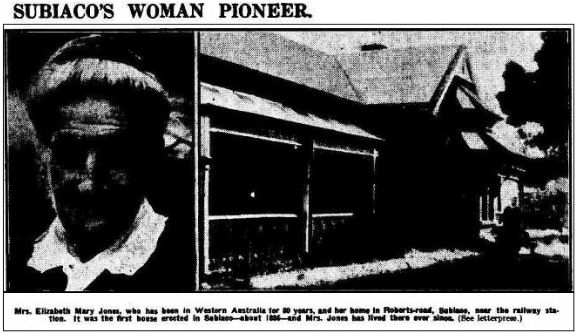
A wonderful story and photographs about one of the early pioneer women in Subiaco, Elizabeth Mary Connor published in The West Australian on 24 September 1932. 


The photograph of Mary Elizabeth Connor and her husband John Rowland Jones at their home in Roberts Road, Subiaco is from the Facebook page of the City of Subiaco. No copyright infringement intended. 


The article is copied from Trove, the database of the National Library of Australia. No copyright infringement intended, 


West Australian,  24 September 1932.


PIONEER OF SUBIACO.


MRS. JONES'S MEMORIES. 


First House in the Suburb.


On April 28, 1853 the barque Palestine dropped anchor in Gage Roads, Fremantle. The vessel had taken six months to make the voyage from England to Fremantle.


Among the passengers who went ashore was Elizabeth Mary Connor, then barely three years of age, a native of Cornwall, who had made the trip with her parents. The child grew up in the colony and later married Mr. J. Rowland Jones, short-hand reporter and journalist, and went to live in the first house built in Subiaco, now 365 Roberts-road, Subiaco, about 20 chains east of the railway station. She lives there still. 


In the sitting-room of this house yesterday, Mrs. Jones recalled her long life in Western Australia. Often the corners of her mouth would wrinkle in a smile, and her keen eyes would twinkle, as she wove a humorous thread into the fabric of her story. 


There was enough and to spare of work, sorrow and fun in the life of the early settlers. Elizabeth Mary Connor first lived with her parents in a little cottage in front of the Perth railway station. The Globe Hotel now probably stands on the site of the old cottage. From that house they shifted to a cottage at the bottom of Mill-street, near Lefroy's garden, on which Winterbottom's Garage 'now stands. Later the Connor family went to live in Mount's Bay-road. 


Mrs. Jones's father went to Victoria in a gold rush. He sent her mother sums of money, and expressed his intention of making a home for his family, but he was never heard of again. Mrs. Jones's mother married a second time. Elizabeth Mary's stepfather was in charge of one of the "Puffing Billies" on the river.


“Puffing Billy." 


This "Puffing Billy" was used to take stores up and down the river. When the Fremantle bridge was being built, timber was taken from the upper reaches of the Swan River at Guildford to the port. Comparatively small lengths of timber were stacked on the deck of the small craft and one or two piles, according to size, were chained on each side of the vessel. 


The old bridge, later superseded by the present Causeway, was frequently under water in the winter months. Mrs. Jones and her sisters often went down to see the new Causeway being built. A barge was provided for taking horses and carts across the river during the winter. After being educated at the Convent of Mercy, in what is now Victoria-square, Mrs. Jones undertook dressmaking. She made dresses for the ladies of many of the old families. The Misses Leake were among her clients. When the third daughter of the Leake's became Lady Parker, the wedding dress was the work of Miss Elizabeth Mary Connor. The wife of Bishop Parry, who before her marriage was a Miss Leake. was another of Miss Connor's clients, among whom were the Burts and the Roes, and many other families. 


When she was 23 years of age Miss Connor was married in St. Mary's Cathedral to Mr. J. Rowland Jones. Father O'Reilly, who later became Roman Catholic Archbishop of Adelaide, celebrated the marriage, and Mr. John Whitely, who was subsequently Commissioner of Taxation in Western Australia, was the best man. In the early days of the colony. Mr. Jones was employed as a shorthand writer to the Legislative Council. With the establishment of Responsible Government he became shorthand writer to the Legislative Assembly. For a time Mr. Jones was editor of the "Western Australian Times," which was later merged with the "Perth Gazette" and became '"he West Australian." There was little money in the colony in the early days and the workmen had to take orders upon storekeepers as wages. The storekeeper supplied the man's needs and gave him cash to pay his butcher and other tradesmen. 


About 1886 Mr. and Mrs. Jones decided to build a residence about three miles west of Perth at a spot on the opposite side of the railway line to the Benedictine monastery. Before the house could be constructed, water was essential. Steps were taken to sink a well. The "experts" said water would be found at 18 feet. Bricks were scarce and orders had to be placed with the brickmakers at Guildford a long time ahead. Bricks sufficient to line a well to a depth of 24 feet were obtained. At 24 feet there was no sign of water. Another order for bricks was given, again on the advice of the "experts." But again water was not located. It was only when the well had been sunk to a depth of about 60 feet that water was obtained, and the construction of the house could be begun. The well took nine months to sink. 


Camel Teams from Fremantle. 


A railway platform had been constructed almost immediately in front of the house, which now stands in Roberts-road, Subiaco. The platform was about 20 chains east of the present railway station. There were three or four trains a day between Perth and Fremantle when Mr. and Mrs. Jones went to Subiaco to live. After leaving Perth, the only other buildings near the railway line were a few houses in Colin street, and a house and woodyard near the Leederville station. Camel teams journeying from Fremantle to the goldfields frequently passed the lone house at Subiaco. 


Before Broom-road (Hay-street) was extended to Subiaco it was not unusual for Mr. and Mrs. Jones in their cart to take the wrong track and become temporarily lost in the bush. When Mr. Jones was working on the "Western Australian Times" and on Hansard, a light was left burning behind a window of the Jones's homestead to guide him home. At night the train stopped at the little platform when a match was struck or a lighted lamp was held aloft. Mr. Jones died in 1895.


Mrs. Jones has many treasures. They include old documents, a copy of the jubilee issue of the "Western Australian Times," edited by her husband, and other papers, an old prayer book which belonged to her father, and which is over 200 years old. She sets great store by two needlework pictures which were brought to the colony by her mother. The pictures, exquisitely worked, are claimed to be over 300 years old. On the voyage to Australia the captain of the barque offered Mrs. Connor £5 each for the pictures. "If they are worth £5 to you," she replied, "they are worth £5 to me." 


On Wednesday Mrs. Jones journeyed to Fremantle to welcome a son home from Singapore. She has nine children, 19 grand-children and one great-grandchild. On May 31 last she celebrated her 83rd birth-day. Time does not hang heavily on her hands. "A little sewing and reading,"' was how the "mother" of Subiaco described her interests.



Wednesday, 8 March 2023

Woman's History Month...2023. Post 8... My Great Grandmother's House...100 Blog Posts.

Woman's History Month...2023. Post 8... My Great Grandmother's House...100 Blog Posts.

This month is Women's History Month. I have decided to repost the stories of many of the wonderful women from Subiaco I have come across. 

While this is not about a woman from Subiaco these articles were a special find on Trove. 

My Great Grandmother's House...100 Blog Posts.

I never knew my great grandmother or grandfather. I did not know my grandmother who died in 1952. My grandfather died in 1973 when I was 10 years old. I learnt a little bit about my mother's side of the family and where they were from over the years through stories told to me by my mother and a collection of photographs. 

My interest in family history started when I found my grandmother's death notice on Trove, the database at the National Library of Australia. It was very emotional reading the notice. When I did a basic search of my grandmother's maiden name I found a collection of articles from a variety of sources. There were a number of articles collected via a brother who served in World War One in a Lighthorse Brigade created from documents from the Australian War Memorial and National Archives. There were articles about a sister who married a man who later became a mayor of East Fremantle.

Many of the documents about the history of the Wheelock family were collected for a page about a soldier in World War Two named Jack Logan Wheelock, the son of Darcy Logan Wheelock and Enda Elizabeth Wheelock (nee ILes) called 'WX8753 Wheelock Jack Logan - 2/4 Machine Gun Battalion'.

An entry from Friends of the Battye Library...

"WHEELOCK, CHARLES THOMAS, b. Toodyay, d. 15-5-1916, m 16.6.1885 (Carnarvon) Jessie Nevin McJANNET. Chd May Elizabeth Wheelock b. 1886 d. 1964 (Carnarvon owned drapery store), Darcy, Gerald d. 1964. Shepard at Irwin, drover of flocks into Gascoyne district. In partnership with G.J. Gooch, established "Wandagee Station" 1880. Was at meeting there when 1st Gascoyne Rd. Bd. was formed 1882. To Carnarvon, built "Red House" 1883. Town councillor employee as well as station manager, town butcher. Pesbyt..."     

The highlight of my search came when I searched the Royal Historical Society of Western Australia collection of digitalised photographs. I found a photograph titled 'Cotton Palm At Site of Red House Carnarvon'. The summary read "Cotton palm at site of Red House. Carnarvon. Note 'May Wheelock's birthplace and her mother's treasured cotton palm in a week enshrouded garden on the banks of Gascoyne River, Carnarvon. The cotton palm was grown and cared for by Mrs. C. Wheelock who built the Red House in the background. The wheels etc are all that remain of early transport". The photograph was by R. Scott-Memory.

There is also a photograph of May Elizabeth Wheelock. The summary of the photograph reads "In front of the home her father built in 1884 - Red House at Yankee Town on the Gascoyne River. Carnarvon. Verandahs were added later." The photographer was R. Scott-Memory. 

There is a considerable amount of information about their family home the Red House. The Red House is a heritage listed building on the Inherit State Heritage database. 

"...History

The Red House was built around 1883 in what was known as Yankee Town about three miles from the town centre. It was built by Charles Wheelock for his bride to be Jessie Nevin McJannet whom he married in 1885. They had six girls and two boys, the first child being the third white child to be born in Carnarvon. Their child May Elizabeth born in 1886 lived for seventy eight years in Carnarvon. Bricks were handmade mud bricks from the red soil. The house was renovated by Ann and Mike Kerswill and a portion of the mud brick section was left for tourists and interested people to see. The Cotton Palm is almost as old as the house having been planted by the Wheelocks from a seedling brought home in Charles Wheelock’s saddle bag from a droving trip and nurtured through drought seasons by Jesse. At one time, Aboriginal mothers and children used to hide and sleep under the beds in the Red House for fear of the ‘Gum mint’ (government) Man coming to get them (a law at that time was to separate the Aboriginal children from their mothers). The Red House is one of the few remaining homesteads and has stood for over 100 years through cyclones, floods and droughts and should continue to do so for much longer.

Physical Description

A hipped roofed dwelling with a surrounding partly enclosed verandah. The bricks used in the construction of the house were hand made locally. The original owners were the Wheelocks..."

The dream is to go up to Carnarvon and visit the house. Writing family history is very emotional. While I have learnt a lot from those who have kept records and photographs of the past  there is still a long way to on this journey. 

The photograph below is from the Royal Historical Society of Western Australia. The photograph below is from the Inherit database. No copyright infringement intended. 


Women's History Month...2023. Post 7. Mary Harding's Recipes And Household Hints... (1910 - 1931).

Women's History Month...2023. Post 7. Mary Harding's Recipes And Household Hints... (1910 - 1931).

This month is Women's History Month. I have decided to repost the stories of many of the wonderful women from Subiaco I have come across. 

Mary Harding's Recipes And Household Hints... (1910 - 1931).

Mrs. M. Harding (nee Livingstone) of 220 Barker Road, Subiaco send in recipes and household hints to the Sunday Times Recipe and Household Hints competition between 1910 and 1931. Miss L. Harding and Miss E. Harding from the same address also sent in entries. The entries won over a hundred prizes and honourable mentions and were published in the newspaper. 

The WA Postal Directories show that an Alexander Livingstone, a contractor was registered at 220 Barker Road, Subiaco. Alexander was one of three brothers and sisters, Mary, Flora and John. After the death of Alexander in 1911, the sons carried on the business as Livingstone and Sons.

Mary Livingstone married a Mr. G. Harding, a builder from Collingwood, Melbourne. It is difficult to know whether Mary Harding and her family lived at the address or just used it as a mailing address for the competition. 

Alexander Livingstone, the son married Minnie. Together they had eight children Mary, Lottie, Minnie, Flors, Alec, Jack, Dave and George. Alexander was also registered at the address. Minnie their mother was registered at the address until her death in 1946.

Mary's recipes and household hints provide a wonderful insight into the type of meals provided and practical household hints. The recipes included traditional meals, desserts, cakes, preserves and jams, drinks, snacks and confectionary. She also provided practical household hints which are still used today.     

The articles are from Trove, the database of the National Library of Australia. No copyright infringement intended.    


Sunday Times, 14 July 1912.

SECOND.

Second prize is awarded to Mrs. M. Harding, 220 Barker-road, Subiaco, for recipe for

WINTER STEW.

Two pounds of best end of neck of lamb, l oz. of dripping, l oz. of flour, 2 lb. new potatoes, 1 pint of cooked peas, a sprig of mint, 2 onions, pint and a half of stock or water. Wipe the meat, cut into neat chops, heat the dripping, fry the chops slightly, then the sliced onions and flour; next add the stock, and stir until it boils. Season it carefully, lay in the meat, and simmer very gently for an hour and a half. At the end of the first hour lay the potatoes and mint on the meat; when the stew is sufficiently cooked, take out the mint, arrange the meat on a dish, put the potatoes round, it, arrange the cooked peas as a border round the edge, and serve very hot.


Sunday Times, 6 July, 1924.

Recipes.

Honorable Mention.

Shepherd's Pie.- Cut the meat in slices, and dip them in a mixture of salt, pepper, and a little powdered herb put a layer of these slices in a deep piedish, then add some minced onion, and thinly sliced potatoes, with a little seasoning, more meat, onion, and cover with a thick crust of smoothly mashed potatoes. Pour over all a little milk, smooth the top with a knife, and afterwards mark the potato crust in small squares with a knife dipped in milk. Heat through in a good oven, and serve when the top is browned. Mrs. M. Harding, 220 Barker-road, Subiaco.


Sunday Times, 22 January 1922.

Third Prize

Third Prize is awarded to Mrs. M. Harding, 220 Barker-road, Subiaco, for recipe for

PEACH MELBA.

Take season fine fresh peaches and peel them by dipping, each one quickly into boiling water, when the skin will drop off. Cover them with vanilla flavored syrup, and let them steep, for a time on ice or in a cool place. When it is time to serve them, place them on a mound of ice cream and pour over them a raspberry sauce.


The Sunday Times, 27 February 1916.

First Prize 

First prize is awarded to Mrs. M. Harding, 220 Barker-road, Subiaco, for recipe for

PASSION-FRUIT CAKE.

Take one dozen passion-fruit, 1/4 lb. butter, 1/2 lb. flour, 1/4 lb. sugar, two eggs, and one teaspoonful of baking powder. Open the passion fruit, put the pulp on a hair sieve with a little sugar, rub it through; beat the butter and sugar to a cream, drop in the eggs, and when well mixed pour in the juice of the passion fruit. Beat the flour and baking powder in with a spoon. Line two sandwich tins with buttered paper, divide the mixture, and pour it in; bake in a moderate oven for about half an hour. When cold spread the following mixture in between the layers; beat the white of one egg to a froth, add 3/4 lb. powdered sugar and the juice of two passion fruits. Spread the jelly on the cakes, and lay one above another. Spread the top of the cake either with whipped cream or white icing.


Sunday Times, 25 September 1910.

Recipes.

Honorable Mention. 

ROCK BUNS. - Rub quarter pound lard into one pound flour, then add quarter pound sugar, two large teaspoonsful baking powder, quarter pound currants, (cleaned), and three eggs, well beaten, with sufficient milk to make a stiff paste. Drop it upon a greased tin in small pieces, and bake in a hot oven.- Mrs. M. Harding, 220 Barker-road, Subiaco.


The Sunday Times, 26 October 1924.

Recipes.

Honorable Mention. 

Butter Scotch. Take 1 1/2 lb soft sugar, 1/2 teaspoonful cream of tartar, 1/2 cupful of cold water. Place all the above ingredients into a clean enamelled pan place in a hot place, and let it boil, without stopping or stirring for 10 minutes. Then dip a spoon into cold water, pop it quickly into the pan and back again with mixture on it into the cold water, when if the mixture hardens, it will do: if it does not boil a minute or two longer, then test again. You may add , if liked, a little ginger or vanilla essence, just before pouring out. When nearly cold mark into squares which, when quite cold, break apart. Mrs. M. Harding 220 Barker-road, Subiaco. 


The Sunday Times, 24 January 1926.

Recipes.

Honorable Mention. 

Ginger Beer. - Put 1 handful cruised ginger, 1 eggcupful cream tartar, 2 lb. sugar in a bucket, and half fill with boiling water. When cool, fill the bucket with cold water and add one cup yeast. Let stand overnight, then strain, bottle and tie down. Ready for use in from three days to a week. If two or three crushed eggshells are put in the bottled liquid they will dissolve by the time it is ready for use, and there will be no sediment. - Mrs. M. Harding, 220 Barker-road, Subiaco.


The Sunday Times, 6 November 1910.

Recipes.

Honorable Mention.

PICKLED ONIONS.

Skin the onions, fill the jars, and cover with salt and water in the proportion of one tablespoonful of salt to one pint of water. Let them stand three days to draw out the unpleasant odor. Boil together one quart vinegar, quarter pound whole ginger, and quarter pound allspice for five minutes. Draw aside, and let it cool to the warmth of new milk. Pour water, off onions, fill up with vinegar, and cork tightly. The onions will be ready for use in two days, and will keep good for three months.- Mrs. M. Harding, 220 Barker-road, Subiaco.


The Sunday Times, 23 July 1911.

THIRD.

Third prize awarded to Mrs. M. Harding; 220 Barker-road, Subiaco, for 

hint on

USES OF SALT.

Salt may be made useful in many directions besides table use. First, as a tooth powder, it will keep the gums hard and the teeth beautifully white; also, if you have a tooth extracted and the bleeding does not stop, rinsing the mouth with salt and water will prove a quick remedy. Mixed with hot water, salt makes a good gargle for a sore throat, and if a little is put with lemon juice stains on stains from ink, peeling potatoes, etc. will be easily removed: When teacups are discolored rub a little salt on the stains before washing them, and tile blemish quickly disappears.


The Sunday Times, 12 November 1912.

Household Hints.

Honorable Mention.

Dispensing with the Plumber.- If the pipe of your kitchen sink becomes clogged, place your hand over the drain, being careful to bold the sides of the hand and tips of the fingers firmly on the sink. Allow water to the depth of one inçh to run into the sink, then raise and lower the palm of the hand until you think the impediment has been removed. After this pour a quart of scalding water and soda down the pipe. This will carry away any waste that remains.- Mrs. M. Harding, 220 Barker-road. Subiaco.


The Sunday Times, 27 July, 1913.

Household Hints.

Honorable Mention.

To Cure Sleeplessness.- Often a person who cannot easily go to sleep will find that sleep comes naturally after a very hot bath. One should immediately retire; for the hot bath Is exhausting, thus producing longer and a natural desire to sleep. - Mrs. M. Harding, 220 Barker-road, Subiaco.


Women's History Month...2023. Post 6. Rose Fuhrmann...The First Woman Elected To The Subiaco Council (1945).

Women's History Month...2023. Post 6. Rose Fuhrmann...The First Woman Elected To The Subiaco Council (1945).

This month is Women's History Month. I have decided to repost the stories of many of the wonderful women from Subiaco I have come across. 

Rose Fuhrmann...The First Woman Elected To The Subiaco Council (1945).

Rose Fuhrmann was the first woman to be elected to the Subiaco City Council in 1945 as an endorsed Labor candidate. She was involved in the Australian Labor Party and worked extensively in the community and in particular Subiaco. Among her achievements were establishing a free kindergarten and Chairman of the Advisory Board to the King Edward Memorial Hospital. 

In 1944, the year before Rose Fuhrmann was elected to the Subiaco Council and the newspaper the Westralian Worker provided a brief overview of some of the causes she was involved in as a member of the Subiaco branch of Australian Labor Party... 

"All Labor women will be interested to know that at the last meeting of the Subiaco A.L.P., Mrs. Rose Fuhrmann, who is a lifelong and most active member of this movement, was elected president of the branch. 

Mrs. Fuhrmann has been for years the chairman of the State Children's Boarding-out Committee; she is vicepresident of Perth Labor Women, a member of the Central Executive, treasurer of the Women's Justices' Association, and when the Advisory Board to the King Edward Memorial Hospital for women was recently reorganised by the Minister, Mrs. Fuhrmann became its chairman. Not only her services but also her home in Subiaco has long been at the service of the movement and many socials and welfare work gatherings have been held there, as well as meetings of the A.L.P. and electioneering committees..." (Westralian Worker, 5 May 1944)

In 1945 the Westralian Worker reported Rose Fuhrmann's success at being elected in the Subiaco City Council... 

"Labor Women Mrs. Fuhrmann Succeeds. Most cordial congratulations go out from all Labor women and men in this State to Mrs. Rose Fuhrmann, J.P., who, on Saturday last, won a seat in the Municipality of Subiaco. This was Mrs. Fuhrmann's second try. She has a splendid record of social service to the State as well as to Subiaco. She conducted her campaign, as becomes every Laborite—without personalities of any kind. She won entirely on her merits and that is the right way.

Labor women will, we feel sure, give her every possible help and we know that she will do us honor. It is more than gratifying to know that Mrs. Fuhrmann achieved her victory as an endorsed Labor candidate, and should clear up the doubt as to whether or not endorsed Labor candidates can win In municipalities..." (Westralian Worker, 30 November, 1945). 

This following article from the Westralian Worker in 1942 provides an extensive overview of Rose Fuhrmann's involvement and community work in Western Australia... "Mrs. Rose Fuhrmann. This week we will try to review the very effective work for Labor of Mrs. Rose Fuhrmann, who was born in Jarrahdale. While his family of five was still very young, her father, a railway ganger, was injured in an accident. A spinal injury left him a cripple for the remaining ten years of his life. His wife, with her large family and maimed husband, had no compensation which should make us all appreciate things as they are to day, though much is still left to be desired. On the very day which the family came to Perth to attend the funeral of her father, the first train ran from Perth to the Bunbury races, the Government having taken over the line from the late Neil McNeil.

Mrs. Rose Fuhrmann first came into contact with the A.L.P. through the Timber Workers' strike, her husband afterwards becoming one of the stewards of the union. In 1907 Mr. Justice Burnside made a timber workers' award of 52 hours per week, the rates of pay ranging from 12/per day to 7/3 per day. This was no good for men with large families who were kept ever on the breadline; so they resolved to strike. This strike was a wonderful effort by men who were not properly organised, and it lasted 14 weeks. A committee was formed and delegates were sent to Perth to ask help from Labor members, especially the late J. B. Holman (reports of whose good work on the goldfields had reached the Southwest). Mr. Holman and his colleagues worked hard in this connection and paid many visits to the scene of the struggle. The men returned to work with better hours, a small rise in pay, the right to organise, or to carry on the mills on a co-operative basis. Mr. Holman was appointed secretary.

The women of Jarrahdale played their part well in that conflict as when Mr. Teasdale Smith brought men from another part to work the local mills the women formed a line (through which the new arrivals had to pass) and interviewed each one personally, with the result many of these men, after hearing of the misery the wives and children of the strikers had endured, did not start.

During that strenuous time Mrs. Fuhrmann came into contact with the Holman family, and Messrs. Collier, Troy, Walker, Bath, Mamie Swanton, and others. When, after the strike, a big social was held Mrs. Fuhrmann's home was used as a dressing room and refreshment centre, when the helpful members of Parliament were presented with polished jarrah walking sticks.

On another occasion Mrs. Fuhrmann's home was the scene of a dinner tendered to the then Labor Premier, Mr. J. Scaddan; Mr. Peter O'Loughlin and Sir. Dave Watson, by the Timber Workers' Union. At this time the two latter guests were working hard to establish the "Worker," in which the Fuhrmann family are shareholders.

Soon after the Fuhrmanns moved to Perth and settled in Subiaco, where Mrs. Fuhrmann took an active part in the conscription campaign and in most of the Parliamentary  and municipal elections which have happened since. After establishing her home in Perth Mrs. Fuhrmann spent two years in Collie. With Mr. Wilson she had travelled that electorate to meet Mesdames M. Green and the late Jean Beadle, who were engaged in platform work in a State election. About this time Rose Fuhrmann chaired a women's rally in Collie of which Collie Women's A.L.P. was born. This branch has the biggest membership roll of any women's branch in the State.

One is often astounded in reading up the lives of many Labor leaders at the multitude of reforms and alleviations for the masses in which they took a part. But to read the life records of many of those women now in the movement who are apt in some quarters to be regarded as just members of a gossip group, is to have one's eyes opened indeed, creating a lasting wonder as to how so many women with such large families found time so to spend themselves in an honorary or any other capacity. Returning to her home in Perth Mrs. Fuhrmann became a delegate to the Labor Women's Central Executive and to the Metropolitan Council, and also vice-president of the Perth Labor Women's Organisation. 

She was an official visitor to the Aged Women's Home, helped in the establishment of an infant welfare centre and a relief committee at Subiaco, and in raising funds to found a free kindergarten. She remained for years the trustee of £74 collected, which was finally handed over to the Kindergarten Union to be used in Subiaco for the purpose named. That dream is not yet realised. This comrade was very active years ago as a member of the Housewives' League in helping the agitation to establish proper markets in the city, and as a first result the kerbstone markets in Wellington-street were opened opposite the Goldfields Hotel. After that, when Mr. Troy was framing the Markets Bill, she was one of a deputation which discussed the Bill with the Minister and made certain suggestions in respect of it for which he thanked them warmly.

Mrs. Fuhrman has always taken a keen interest in everything that has to do with child-life and was long since appointed to the State's boarding-out committee for poor children. In due course she was appointed secretary, which position she held for five years, while for the last four years she has been the chairman of the committee. Mrs. Fuhrmann is a Justice of the Peace and has been treasurer of the Women Justices' Association for some years, active in the local R.S.L., whose funds she has audited for years, delegate for Perth Labor Women on the Fellowship of Educational Research. and a canteen worker for soldiers. She was a member of the Labor Women's Choir, founded by the late May Holman and is now senior vice-president of the Labor Women's Central Executive. All will agree that the name of Mrs. Fuhrmarm is justifiably added to the Labor Women's Roll of Honor.

A footnote can be added that Mr. Fuhrmann has been an ardent and loyal trade unionist throughout, who has aided and abetted his wife in the good work (Westralian Worker, 24 August. 1944)..." 

In 1950 Rose Fuhrmann wrote the following letter to the Age newspaper correcting them on a story about women Cabinet ministers in Australia. Mrs Florence Cardell-Oliver member for Subiaco in the Legislative Assembly was the first woman to hold such a position. 

"Women in Cabinet A statement appeared in your issue of April 5 claiming that Dame Enid Lyons is the first woman to be appointed to Cabinet rank in this country. Mrs. Florence Cardell-Oliver, member for Subiaco in the Legislative Assembly of West Australia for 12 years, has held Cabinet rank ever since the McLarty L.C.P. Government was elected three years ago first as Assistant Minister for Education and afterwards as Minister for Health, and also ; for Supply and Shipping, with cabinet rank. She has proved her ability in these important Cabinet positions— (Cr.) ROSE FUHRMANN, J.P, (Subiaco, W.A)" (The Age 12 April 1950).

The articles and photographs are from Trove, the database of the National Library of Australia. No copyright infringement intended.


Tuesday, 7 March 2023

Women's History Month...2023. Post 5. Adelaide Ilfra "Queenie" Chugg...(1898 - 1981).

Women's History Month...2023. Post 4. Adelaide Ilfra "Queenie" Chugg...(1898 - 1981).

This month is Women's History Month. I have decided to repost the stories of many of the wonderful women from Subiaco I have come across. 

Adelaide Ilfra "Queenie" Chugg...(1898 - 1981).

"Miss Queenie Chugg expresses' her opinion and considers it is essential for women to be able to state their views in a capable manner at all times, and to help West Australians in the country the Penguin Club hopes to establish groups for this purpose, and indeed most states have already formed country branches. What an opportunity for the shy but intelligent woman to join this movement and learn to speak as a delegate, and take the chair when it is necessary without feeling nervous1 (Reliance Weekly, 19 November 1953).

This blog post is a continuation of the previous blog posts "Alexandra McKinnon Burns... Subiaco Business Woman (1938)", the "Lipfert Sisters" and "Ethel Maude Thomas" about the women mentioned in the Museum of Subiaco exhibition on International Women's Day. This post is about Adelaide Ilfra Chugg, a Subiaco business woman. 

The following information about is from the previous blog post..."During March International Women's Day was held. The Subiaco Museum created an exhibition to highlight the contribution of women to the Subiaco community. 

The women included Alexandra McKinnon Burns (1864 -1961), Dame Annie Florence Gillies Cardell-Oliver (1876 - 1965), Adelaide 'Queenie' Chugg (1898 - 1981), The Lipfert Sisters (Minna Maria Lipfert (1902 – 1959), Olga Gertrude Lipfert (1906 - 1989) and Thekla Elsa Lipfert (1912 - 1989) and Ethel Maude Thomas M.B.E (1881 - 1961). The exhibition contained a number of wonderful photographs and artefacts and are available on the webpage from the Subiaco Museum.

While there is a substantial amount of information information about the exceptional work and life of Dame Cardell-Oliver available on various sites on the Internet, Trove, the database of the National Library of Australia contains some wonderful information and photographs about the women mentioned by the Subiaco Museum in their exhibition..."

Simon and Louisa Matilda (nee Atkins) had two children Adelaide Ilfra (1898) and Rita Winifred. 

From the Subiaco Museum webpage...

"...Adelaide Ilya Chugg was born in Subiaco to Simon and Louisa Chugg. The Chuggs lived at 168 Townsend Road, Subiaco and established a business S Chugg & Co. Importers in Railway Road Subiaco, 1897. Adelaide received her teachers diploma from the Trinity College of London in 1937.

In 1979 Miss Chugg donated an outdoor chess table for use in Council Gardens in memory of her father.  Miss Chugg and Miss Daglish were invited to open Subiaco Historical Society's Museum in November 1975 by turning a golden key in the door.  They were the first people to enter and sign the visitor's book.  

Known affectionately as ‘Queenie’, Miss Chugg was the founding Vice-President and later Patron of the Subiaco Historical Society. She gave generously during her life to the museum and her bequest at her death in 1981 to the Museum made the interior refurbishment and new displays possible. Her donations included furniture made from Australian timbers, such as a Tasmanian cedar chest of drawers, a jarrah book shelf, documents, photographs and a set of lace-making bobbins. At the end of the Museum's entrance hall is a glass fronted display case marked by a plaque acknowledging the bequest made by Miss Chugg. The bequest provided for the construction of the display case and also allowed for significant improvements to and refurbishment of, the interior of the Museum, including the restoration of its magnificent jarrah floors..."

Trove, the database of the National Library of Australia provides many articles about Adelaide "Queenie" Chugg as she was regularly mentioned in the local social scene and involved in the dramatic arts scene producing and starring in productions. Many of these productions were held in the Subiaco library and other venues around Perth. They were well attended and received great reviews in local newspapers.  

Throughout her life Adelaide was involved in many causes including the committee for the West Australian Elocution Teachers' Association. Adelaide was a committee member and president of the Marlow Club. She produced and starred in plays for Felica's Art of Speech Club, the Marlow Club and Mrs. Walter M'Rostie's Dramatic Society that raised money for various causes around Perth. In the 1950's Adelaide was secretary of the West Australian Penguin Club for over eight years.  

In 1953 the West Australian published the following article about Adelaide's work in the West Australian Penguin Club who attended a conference in Sydney...

"Women Must Be Able To Express Views....It is essential, now that women are "taking their place," for them to be able to express their views in a capable manner. The secretary of the West Australian Penguin Club (Miss Queenie Chugg) who recently returned from the club's interstate convention in Sydney, said this yesterday. To help West Australian country women, Miss Chugg said, the club hopes to establish groups in country centres. New South Wales and Victoria had already formed several country branches. All States except Queensland had an active Penguin Club and delegates at the interstate convention were women from all walks of life, Miss Chugg said. Many were business women and wives of politicians and others were mothers and housewives. This State had 130 members and they were divided into groups of 25 so that each member had an opportunity to speak and take the chair. At the final meeting of the convention five women, one of whom was Miss Chugg, spoke on Australia's future in world affairs. Miss Chugg and the three other West Australian delegates, Mrs. W. H. Barndon, Miss R. Daglish and Mrs. J. A. Cundill, were given a welcome home party, last night" (West Australian, 10 November 1953).

The "J S Battye Library of West Australian History Ephemera Collection – Collection Listing Pioneer Women’s Memorial Fund" states that A. I "Queenie" Chugg was involved in extensive community work that included "Foundation member W.A. Branch Penguin Club 1945, pioneered establishment of W.A. branch. Member of Soroptimists Club, Tree Society, National Trust and many others."

Adelaide "Queenie" Chugg died on 29 December, 1981 and was buried in Karrakatta Cemetery in the Anglican section. She was 81 years of age. 

Note...The birth certificate and Karrakatta burial details state different middle names for Adelaide "Queenie" Chugg. The birth certificate states her middle name was Jefra. There was no death certificate registered. The burial details state her middle name was Ilfra. 

The articles and photograph are from Trove, the national database of the National Library of Australia. No copyright infringement intended. 


The West Australian, 18 Nov 1938 (photo)


Daily News, 16 December 1929.

SUBIACO INSTITUTE

Musical & Dramatic Evening,

To an audience filling the Subiaco Library and presided over by Mr. G. Olney, the Mayor, the Subiaco Civic Dramatic Society, presented on Wednesday evening, December 11, two sketches, both of which were attractively staged.

'Dearest Mama,' the name part taken by Miss Rae Daglish, belied her name and made herself successfully obnoxious in disrupting the honeymoon harmony of a hymeneal couple (played by Mr. H. Betteridge and Miss Queenie Chugg) throughout the piece and succeeded admirably in railing foul of the household guests, Uncle Browser (Mr. Allan O'Keefe) and Mr. Croker (Mr. Lewis Weeden), and also provided excuse for the sudden departure of an attractive maid (Miss Jean Galbraith.) But eventually, by the comfortable stolid placidity of Uncle Browser and gentle shatts of sarcastic raillery from Mr. Croker. 'Dearest Mama' was deported , to the tender matrimonial mercies of distant cousin Towzler. Mrs. Honeywood, an attractive widow played by Miss Betty Moore, innocently provided fuel for the wrath of 'Dearest Mama.' The second offering was a short' sketch, 'Mrs. Hamblett Records Her Vote,' and provided ample opportunity for farcical effects, and Mrs. E. A. Donegan as the garrulous, if not bibulous ancient voter, with deaf ears and blind intellect, left no stone unturned in her efforts at obtuseness. In this she was ably supported by her daughter Gerty (Miss Rene Roberts), the pair making strenuous demands on the limited patience of the returning officers (played by Mr. G. Coxon and Mr. L. T. Boas.) This was a diverting piece of work and left the audience in high good humor. The success of the initial productions of this society augurs well for . their future efforts. Musical and elocutionary items of first-class merit were provided by Mr. Lyall Richardson, Miss Gillett, Mr. H. Neate, Miss Edna Williams, Miss Joyce Fuller and Miss Bloxsome. A delicious supper concluded a happy evening's entertainment.


Daily News, 4 March 1930.

MAINLY ABOUT PEOPLE Here, There and Everywhere

The Subiaco Library was filled to its utmost capacity last Wednesday evening, when the members of the Subiaco Civic Dramatic Club held a social evening, presided over by Colonel Roberts, D.S.O. A delightful musical and elocutionary programme, each item of which won enthusiastic applause, was contributed to by Mr. Harold Betteridge, Miss Willmott, Miss N. Shortland-Jones, Mr. and Mrs. Hemmingway, Mr. Orgill, Miss Simpson, and the graceful dancing of Miss Felicity Sands was much admired. A feature of the evening was the staging of a one act play entitled 'Followers.' produced by Miss Queenie Chugg. The various characters were cleverly enacted by Miss Nancy Bloxsome, Miss Betty Moore, Miss. Chugg, and Mr. G. Coxon. The old fashioned parlor setting and frocks of 1850 called forth much admiration. Miss Chugg was heartily congratulated on this her first attempt at production. During the evening dainty refreshments were served by the members of the club.


Daily News, 19 September 1931.

Assembly Hall

'All of-a-Sudden Peggy'

Members of Mrs. Walter M'Rostie's Dramatic Society presented 'All of a Sudden Peggy' last evening in the Assembly Hall before a very appreciative audience. Miss Queenie Chugg, who gave a very pleasing performance ot Peggy was consistent and natural throughout, and Mr. W. A. Hoey, who played the Hon. Jimmy Keppel, brother lo Lord Crackenthorpe, was equally successful. 

The work of all on the stage was good, Mrs. M'Rostie taking the part of Lady Crackenthorpe with her usual skill. Each individual in the cast has some fairly difficult character work to carry, and their production was highly commendable. The spider-loving entomologist, Lord Crackenthorpe, taken by Mr. R. Mooney, and the individual who has the good of the family at heart, were both clearly portrayed, Mr. G. Savage giving an impression of naturalness that is not easy. Miss Edna Burgess, as the Hon. Millicent Keppel, carried a minor role capably, as did Miss Iris Parker, who was Hon. Mrs. Colquhoun. Miss Nancy Hill was Mrs. O'Mara, Peggy's mother, widow of Professor O'Mara, F.R.S. Mr. L. Green had the role of a man servant, and Mr. Schuster as Jack Menzies was also adequate. Mrs. M'Rostie was producer, and was responsible for the hundred and one details of work. 

The Subiaco Church of Christ orchestra provide pleasing incidental music. The performance will be repeated this evening, and the proceeds of last evening's work are to be devoted to the unemployment relief funds.


Daily News, 19 September 1932.

Subiaco Dramatic Club.

The Subiaco Civic and Dramatic Club presented three charming short plays in the Subiaco Library ; Mrs. Sands carrying out the duties of producer in her usual capable manner.

The Misses Galbraith, Bloxsome, Neate and and Roberts supported by Messrs. Graham, Weedon, Coxon and O'Keefe were responsible for the success of 'The Bracelet'; J. M. Barrie's .'Twelve Pound Look' received much applause, the liar's being taken by Misses Daglish and Hraly and Messrs. Larrard and Nave. Miss Queenie Chugg and Mr. Nave held the audience breathless during the presentation of 'The Brass Door Knob.' During the intervals musical items were rendered by Mr. L. Richardson, accompanied by Mrs. Dickinson, and wireless selections were enjoyed through the loan of a wireless set by Mr. H. Moody. Miss E. McCallum delighted everyone present with her recitations. At the conclusion of the programme a dainty supper was served by members of the club.


Women's History Month...2023. Post 4. Kathleen Morrisby. A School At The Children's Hospital At Subiaco (1944).

Women's History Month...2023. Post 4. Kathleen Morrisby...A School At The Children's Hospital At Subiaco (1944).

This month is Women's History Month. I have decided to repost the stories of many of the wonderful women from Subiaco I have come across. 

Kathleen Morrisby...A School At The Children's Hospital At Subiaco (1944).

Kathleen Morrisby was a teacher in the Education Department who set up a school in the Children's Hospital in Subiaco in the orthopaedic ward to help young patients remain in touch with their studies while they under went treatment. She was born in Roebourne in 1906.  

During the summer break of the school in 1944 Kathleen travelled to Melbourne and visited several hospitals to learn about teaching children in orthopaedic wards at her own expense. In 1949 Kathleen travelled to England and Europe to study their methods used to educate children with a range of disabilities which were used to assist the children at the Children's Hospital upon her return. 

In 1951 Kathleen obtained a position as principle of Larchfield House in England which was a home for disabled children set up on the Earl of Harewood's estate near Harrogate. During her time there she leant some of the newest methods for the diagnosis and treatment for children with disabilities.  

The West Australian reported about Kathleen's study and work... "Two years ago she went to England to study the latest methods of teaching all types of handicapped children. There were about 80 girls at Palingswick House School, she said, their ages ranging from eight to 16 years. The teaching was remedial, and only 18 girls were in any one class. In addition to ordinary lessons, according to their ability, they had art therapy, pottery, sewing, woodwork, dramatics, speech therapy, domestic science and sewing. Excellent results had been achieved..."(West Australian, 27 June 1951). 

Throughout her life Kathleen was interested in the Girl Guides movement in Western Australia. She established branches and participated in committees and encouraged young girls to become involved.  After Kathleen returned from England and Europe she took on the role of Commissioner for Extension Guiding and set up a play therapy unit for girls at the Claremont Mental Hospital.

The first article titled 'School in a Hospital' Sunday Times, 9 July, 1944 is about Kathleen Morrisby and her work in educating children at the Children's Hospital in Subiaco. Together the children with Kathleen as their teacher achieved some amazing results.

The second article titled 'British Work in Educating Handicapped Children' from The West Australian, 8 August 1950 is about the observations Kathleen made during her study tour and work in England and Europe. She gave considerable praise to the work already being done by professionals for children at the Children's Hospital.

The achievements and work of the children at the Children's Hospital are continued in the next post.   

After Kathleen returned to Perth in 1955, she was appointed Principal of Minballup Occupational Centre and, from 1962, the Specialist Section of South Kensington Occupational Centre until retiring in 1970. She died in December 1990, aged 84.

The articles and photographs are from Trove, the database of the National Library of Australia. No copyright infringement intended. 

Sunday Times, 9 July 1944.

SCHOOL IN A HOSPITAL

Facilities For Sick Children

Since the beginning of the school year, little patients at the Children's Hospital at Subiaco have been having regular school lessons under the supervision of Miss Kathleen Morrisby.

The scheme, which is under the control of the Education Department, enables kiddies to keep in touch with their school work, so that when they return after long absences they can more easily take up the threads of their studies.

Small patients range from three years old to a pupil is up to 5th standard work. Most of them are in the orthopaedic ward, and there are others who are accident cases, or in for treatment for heart or diabetes.

Studies are naturally suited to the capability of the small patients, according to their improvement in health. Besides helping their education the scheme is one which, give them plenty of interesting occupation.

Miss Morrisby said that the three-year-old are most anxious to join in, and demand their paper and crayons when the others are being attended for lessons.

Excellent Standard

The standard of work is very good, some of them, who are In higher grades, possessing wonder fully neat work with lessons which have been well done.

Drawing is the delight of the tiniest, and rabbits and squirrels in startling colors adorn the papers which are given out for the morning's work. Sewing and hand work are also included  in the curriculum.

There are several natives among the cases, and these small boys and girls display keen interest and ability, one little lad in particular, showing quite a talent for drawing.

"It ls the most interesting work." said Miss Morrisey. "I love it. Of course there ls plenty of preparation to be done for the lessons, and one has to see that the work is suitable for the precarious health of the children. They are all very keen, and we get on splendidly."

Classroom Soon

Soon there will be a classroom built for the use of pupils who are well enough to be housed there for lessons, and later on there will be sand-pits and other kindergarten facilities.

Miss Morrisby has plenty of equipment to carry on, and makes quite a number of things requited for the lessons.

Besides being of help and occupational Interest to the sick kiddies, the parents are delighted to think that their little ones are able to keep in touch with school work in such a pleasant way, and feel they will not be so hackward when they take their place again In the regular school.

West Australian, 8 August 1950.

British Work In Educating Handicapped Children 

Special attention was being paid in Britain to the education of physically and mentally handicapped children and remarkable results were being achieved, said Miss Kathleen Morrisby alter her return to Perth last week from England, where she had spent 18 months.

Miss Morrisby, who started the school for orthopaedic patients at the Princess Margaret Hospital, the first of its kind in Australia, went to England to study the latest methods of educating children who were handicapped. 

She has brought back much valuable information gained at first hand. Her visit was welcomed by the London County Council, whose education officer made it possible for her to visit many schools and she worked in some of them. In the area controlled by the L.C.C. there were 83 special schools for all types of handicapped children and the director of the section which controlled them was a woman chosen for her wide experience and knowledge of the particular problems which were met in these special schools, Miss Morrisby said. 

Great progress had been made in educating blind children, and at one school she saw children aged between five and ten years running about and playing as though unconscious of their disability. Their school work was excellent. Children with partial vision were educated separately and by means of special lenses attached to the desk the child was able to use ordinary text books. Miss Morrisby has made inquiries to see whether these lenses can be imported if they can be made use of in Australia. 

SIZE OF CLASSES. Other special schools catered for orthopedic cases in hospital, and for convalescent orthopedics, Miss Morrisby said. One hospital with 800 patients employed 49 teachers, but she saw no hospital school which was so well equipped as that at the Princess Margaret Hospital. 

Children who suffered from a double defect, the mentally handicapped, the maladjusted, and children who had been through the courts for delinquency were all educated in separate schools, and in no case did the number of pupils in a class exceed 15. This made it possible for the teacher to give better attention to each child. 

Miss Morrisby worked for a time at a residential school for girls, all of whom had been through a court for delinquency, and children such as these. she said, were England's greatest educational problem. Deaf and dumb children were equipped with hearing aids, but she saw nothing better in these schools than what was being done at the school for deaf and dumb children in this State. 

LOCAL DESKS ADOPTED. Open-air schools for tubercular contacts had been established in different parts of England and there were hospital schools for heart cases. One of these proposes to copy the type of desks used at the Princess Margaret Hospital and the recumbent spectacles already being used in this State have been introduced to Guy's Hospital and some children's hospitals as a result of her visit. 

During her time in England Miss Morrisby was able to have discussions with leading educationists and psychologists. She later visited Holland, France and Switzerland, combining a holiday trip with visits schools in those countries.

From Celebrating 100 Years PLC OCA by Presbyterian Ladies College

https://issuu.com/presbyterianladiescollege/docs/100_years_booklet_single_pages/s/11343637

Kathleen Edith Mary Morrisby (1923)

1922-1923; Deputy Prefect

Born in Roebourne in 1906, Kathleen grew up in Geraldton where her sisters, Elinor Morrisby (1926) and Isabel Lee (Morrisby 1929), were born. She came to PLC in 1922-1923, after which she worked as a monitor at her old school, Geraldton High, and captained the 1st Geraldton Guide Company. She then attended Claremont’s Teachers’ Training College, with her first posting as Head Teacher at Kulikup State School, in Yallingup, in 1928. From 1929-1930 Kathleen was the OCA’s Geraldton Branch Secretary and, in 1937-1938, OCA President. The next year she became the first female appointed to PLC Council as the inaugural OCA Representative to Council. She served until 1952, and was OCA President again from 1942-1945.

In 1944 she led a new scheme, educating orthopedic patients, aged 3-15, in the Children’s Hospital. She visited interstate specialists to study their methods and, from 1948, embarked on a tour of England and Europe, learning new techniques in the education of tubercular, blind, deaf and mute children. Finding Western Australia led the way in some methods, she brought others back when she returned in August 1950. She then rejoined the OCA committee and, as Girl Guide Commissioner for Extension Guiding, set up a play therapy unit for girls at the Claremont Mental Hospital.

In 1951 Kathleen was appointed Deputy Principal of Palingswick House School in London, for 80 “educationally subnormal” girls aged 8-16, but was soon the Principal of Larchfield House, a home and school for children with cerebral palsy, near Harrogate.

Returning to Perth in 1955, Kathleen was appointed Principal of Minballup Occupational Centre and, from 1962, the Specialist Section of South Kensington Occupational Centre until retiring in 1970. She and her sister Elinor then moved into different apartments in the same complex in Nedlands, where she died in December 1990, aged 84.


Women's History Month...2023 Post 3. Pleasance Durack Her Subiaco Garden And The Free Kindergarten Committee...(1935).

Women's History Month...2023 Post 3. Constance Horrocks (Hon. Secretary S.P.C.A. Subiaco) (1913).

This month is Women's History Month. I have decided to repost the stories of many of the wonderful women from Subiaco I have come across. 

Pleasance Durack And Her Subiaco Garden...(1935). Part 1.

This blog post on Pleasance Durack is the first of two blog posts written about her family life and community work, in particular with the Free Kindergarten Movement. Pleasance was President of the committee who managed the kindergarten established in Pier Street, Perth written about in the previous blog post 'Kindergarten In Perth...(1911) . The next blog post is about Pleasance Durack's community work helping to raise funds for and establish the Margaret Free Kindergarten and Nursery in Leederville opened in 1938.
 
Pleasance Sarah Durack (nee Rowe) was born in Perth in Western Australia in 1891. She was married to John Peter William Durack, an Australian lawyer and QC in 1922. They lived at the historic Federation Queen house "Strathmore" at 18 Chester Street, Subiaco. Together they had one child.
 
So who was Pleasance Durack ? The social pages and women's sections of the early newspapers of Western Australia tell readers a lot about the social life and community work of Pleasance Durack or Mrs. J. P. Durack as she was known.
 
From an early age Pleasance was interested in community work. At the time of her engagement to John Durack she was involved in the Soldiers League working with returned soldiers. The Australian, 18 November 1921 wrote of about the engagement of Pleasance Rowe to Jack Durack..."ENGAGEMENT OF POPULAR COUPLE. Our heartiest congratulations to Solicitor Jack Durack (late 10th Light Horse) upon his engagement. The happy girl is Miss Pleasance (Petty) Rowe, of West Perth. Miss Rowe has done splendid work for the returned men, along at the Soldiers' Institute and elsewhere, and the boys will join us in wishing both these comrades all possible happiness."

After her marriage Pleasance became interested in the kindergarten movement and was President of the Pier Street Free Kindergarten committee that oversaw the kindergarten in Pier Street, Perth. The story of that centre is published on the previous blog post 'Kindergarten In Perth'...(1911). Pleasance held fundraising events to raise money for the kindergarten and later on to establish the Margaret Free Kindergarten and Nursery in Leederville. She was also President of the Margaret Free Kindergarten Committee. Pleasance was a keen gardener and member of the Hunt club.  These events were recorded in the early newspapers on Trove, the database of the National Library of Australia. 

After Pleasance's marriage in 1922, the Durack residence in Subiaco was a feature in newspapers such as the Daily News and West Australia as she was a keen gardener. In 1935 some of Perth's well-known residents were featured in special place in their homes or garden. The first segment showed photographs of Pleasance in a special corner of her garden. The article is copied below. In 1937 the Western Mail ran a special on featuring her garden and photographing her with members of the Hunt' club. The article is copied below.  

Pleasance died on 28 May, 1979 at the age of 87. She is buried in Karrakatta Cemetery in Western Australia. 

Today the former Durack residence at 18 Chester Street, Subiaco is registered as a historic residence and is included on the City of Subiaco walking tours. 

The articles are from Trove, the database of the National Library of Australia. No copyright infringement intended. 

Daily News, 16 April 1935.

Pet Corners of Perth Homes

This is the first of a series of corners of homes of some of Perth's well-known residents. Most women have a special corner in their homes or gardens which have an irresistible fascination for them and, in which they spend as much of their time as is possible.

Mrs . J. P. Durack is particularly fond of this (pictured), corner of tier lovely garden at her home in Chester-street, Subiaco. The hedge which divides the garden from the tennis court is ablaze with hundreds of large gaily-colored dahlias, a tribute to the care which both Mr. and Mrs. Durack put into their cultivation. The side of the house, which is covered with masses of Virginia creeper is a lovely background for the riot of color on the opposite side. 

There are banks of multi-colored phlox, zinnias, a few roses interspersed and then a profusion of dahlias in reds and mauves, and golds and bronzes, and pinks. Mrs. Durack, who is a member of the Hunt Club and a foundation member, of the Repertory Club, is fond of tennis and sewing and keenly interested in the kindergarten movement. 

Her son Peter is just eight years old and at school, so Mrs. Durack has time to devote to the planning and nurture of her garden. 'Our dahlias seem to thrive on special well water' said Mr. Durack, who was painstakingly watering the garden when seen yesterday. 

MRS. J. P. DURACK in the favorite comer of her garden.


Monday, 6 March 2023

Women's History Month...2023 Post 2...Constance Horrocks (Hon. Secretary S.P.C.A. Subiaco) (1913).

Women's History Month...2023 Post 2. Constance Horrocks (Hon. Secretary S.P.C.A. Subiaco) (1913).

This month is Women's History Month. I have decided to repost the stories of many of the wonderful women from Subiaco I have come across. 

Constance Horrocks Hon. Secretary S.P.C.A. (1913).

Constance Horrocks has been given credit for starting the Dog's Refuge Home in West Subiaco/Shenton Park and was honorary secretary for many years of the Society for the Prevention of Cruelty to Animals in Subiaco. 

Constance was born in England and spent most of her life living in Western Australia. She trained as a nurse and worked in various hospitals around the State. 

During her life Constance continually wrote letters to local newspapers raising awareness of the treatment of the cruelty to animals including domestic and farm. In January 1913, she wrote a letter about a boy's act of kindness towards some rams locked in a truck who gave them some food and water during the hot temperatures in December 1913. 

She wrote in her letter how wonderful it was to see children with such compassion for animals  "...I should, like you to give publicity to these true facts, which prove what a splendid thing it is to meet children imbued with a feeling of pity and mercy for animals. This lad, by his thoughtfulness and kindness, saved the animals from indescribable suffering..." (Daily News, 4 January, 1913). In another she raised the issue of the inhumane practice of boiling crabs and other shellfish alive (West Australian, 9 April, 1913).

In an introductory speech for the opening of the Dog's Refuge Home in West Subiaco in 1935... "the president of the committee (Mr. H. E. Denson) paid a tribute to the founder (Mrs. C. J. Horrocks) and the honorary secretary (Mrs. H. A. Plttman), and asked that the excellent work which they had done for a humanitarian ideal should receive from the public the support which it richly deserved. ..." (West Australian, 21 October 1935).

Constance died on February 17, 1948 aged 81. A brief obituary was published on the 22 February, 1948 in the Sunday Times about her stated "...When she came here in the 90's as a nurse, one of her earliest appointments was Matron of Kalgoorlie Govt. Hospital when housed in tents. 

Her health being unequal to the strain she resigned after 6 months and founded the Grosvenor Hospital at Beaconsfield. She succeeded Miss May Moore as hon. secretary of the RSPCA during inspectorates of Titus Lander and R. G. Sexty. 

Among her later activities was the Dog's' Refuge Home as foundress, and the British Union for the Abolition of Vivisection owes much to her zeal."

Constance left the majority of her estate of 7338 pounds to her husband and three organisations that cared for animals including the Shenton Park Dog's Refuge Home, the RSPCA and the WA Branch for Abolition of Vivisection (Daily News, 15 September, 1948).

The articles and photo are from Trove, the database at the National Library of Australia. No copyright infringement intended. 

Daily News, 4 January 1913.

BOYS ACT OF KINDNESS

Sir,— On December 10 last there was consigned to Gilgerring, and arrived there in the early morning, an open truck containing three rams. The temperature was 105 on the 10th, 109 on the 11 and 102 on the 12th. These unfortunates were left without shelter, water, or food. On the morning of the 11 th a school boy passing, near the railway, heard a faint bleating, and looked into the truck and saw the poor animals licking the iron of the truck; be threw down his schoolbag and ran as fast as he could a quarter of a mile for a bucket; of water, which he put into the truck; he then went a considerable distance to a farm and begged a bundle of hay, which this Samaritan gave to the perishing creatures. A resident of Gilgerring, hearing of this lad's act, was so pleased with , it that he communicated with me, asking that some notice be given the boy, and thanks sent him from , the Society, which was promptly done, and a small present sent him in the shape of a book. I should, like you to give publicity to these true facts, which prove what a splendid thing it is to meet children imbued with a feeling of pity and mercy for animals. This lad, by his thoughtfulness and kindness, saved the animals from indescribable suffering, if not from a cruel, death, as with such a temperature they could hardly have, survived 72 hours in an open truck. This boy's name is Robert Heron, aged 15. - Yours faithfully,  CONSTANCE. H. HORROCKS. 22 Hamilton-street, Subiaco, Office of the S.P.C.A, January 2, 1913.

West Australian, 9 April, 1913.

CRUELTY TO' CRABS AND SHELLFISH. 

To the Editor. Sir, I was pleased to read a letter in your issue of the 5th inst. protesting against the cruel custom of putting shellfish into cold water .and bringing them slowly to the boil. One would hardly believe it possible that professedly civilised people would commit such an abominable act, if it were not well attested by evidence and generally admitted. While there is reasonable ground for assuming that the crustacea, being a lower organism, have not the intense capacity for suffering possessed by the Mammalia, yet it is certain that they do suffer an agonising death when boiled alive: as anyone who has seen them will testify. Your correspondent, with the best intentions, suggests this as the proper method of killing them, but I am sure that "K.E.B." and other humane, people will like to know that there is a better way. I am informed by an enthusiastic "crabber" that he always immerses the live crabs in cold fresh water, and that they drown in about 30 minutes. If the municipal Councils would take this matter up, as your correspondent suggests, pass the necessary bylaws and place notices along the river, intimating that shell-fish must be drowned in fresh, water before being boiled, I feel sure it would help to overcome the difficulty; and this Society's inspectors would do their best to co-operate in seeing the by-laws enforced. I am also hopeful that the Prevention of Cruelty to Animals Act may be amended to deal with this subject. In the meantime I trust the public will stop this hateful practice. Yours, etc., CONSTANCE H. HORROCKS, Hon. Sec. S.P.C.A.

The opening of the Dogs Refuge Home in 1935. 


This month is Women's History Month. I have decided to repost the stories of many of the wonderful women from Subiaco I have come across. 

Constance Horrocks Hon. Secretary S.P.C.A. In Subiaco (1913).

Constance Horrocks (Hon. Secretary S.P.C.A. Subiaco).

Constance Horrocks has been given credit for starting the Dogs' Refuge Home in West Subiaco/Shenton Park and was honourary secretary for many years of the Society for the Prevention of Cruelty to Animals in Subiaco. 

Constance was born in England and spent most of her life living in Western Australia. She trained as a nurse and worked in various hospitals around the State. 

During her life Constance continually wrote letters to local newspapers raising awareness of the treatment of cruelty to animals including domestic and farm. In January 1913, she wrote a letter about a boy's act of kindness towards some rams locked in a truck who gave them some food and water during the hot temperatures in December 1913. 

She wrote in her letter how wonderful it was to see children with such compassion for animals  "...I should, like you to give publicity to these true facts, which prove what a splendid thing it is to meet children imbued with a feeling of pity and mercy for animals. This lad, by his thoughtfulness and kindness, saved the animals from indescribable suffering..." (Daily News, 4 January, 1913). In another she raised the issue of the inhumane practice of boiling crabs and other shellfish alive (West Australian, 9 April, 1913).

In an introductory speech for the opening of the Dog's Refuge Home in West Subiaco in 1935... "the president of the committee (Mr. H. E. Denson) paid a tribute to the founder (Mrs. C. J. Horrocks) and the honorary secretary (Mrs. H. A. Plttman), and asked that the excellent work which they had done for a humanitarian ideal should receive from the public the support which it richly deserved. ..." (West Australian, 21 October 1935).

Constance died on February 17, 1948 aged 81. An brief obituary was published on the 22 February, 1948 in the Sunday Times about her stated "...When she came here in the 90's as a nurse, one of her earliest appointments was Matron of Kalgoorlie Govt. Hospital when housed in tents. 

Her health being unequal to the strain she resigned after 6 months and founded the Grosvenor Hospital at Beaconsfield. She succeeded Miss May Moore as hon. secretary of the RSPCA during inspectorates of Titus Lander and R. G. Sexty. 

Among her later activities was the Dogs' Refuge Home as foundress, and the British Union for the Abolition of Vivisection owes much to her zeal."

Constance left the majority of her estate of 7338 pounds to her husband and three organisations that cared for animals including the Shenton Park Dog's Refuge Home, the RSPCA and the WA Branch for Abolition of Vivisection (Daily News, 15 September, 1948).

The articles and photo are from Trove, the database at the National Library of Australia. No copyright infringement intended. 

Daily News, 4 January 1913.

BOYS ACT OF KINDNESS

Sir,— On December 10 last there was consigned to Gilgerring, and arrived there in the early morning, an open truck containing three rams. The temperature was 105 on the 10th, 109 on the 11 and 102 on the 12th. These unfortunates were left without shelter, water, or food. On the morning of the 11 th a school boy passing, near the railway, heard a faint bleating, and looked into the truck and saw the poor animals licking the iron of the truck; be threw down his schoolbag and ran as fast as he could a quarter of a mile for a bucket; of water, which he put into the truck; he then went a considerable distance to a farm and begged a bundle of hay, which this Samaritan gave to the perishing creatures. A resident of Gilgerring, hearing of this lad's act, was so pleased with , it that he communicated with me, asking that some notice be given the boy, and thanks sent him from , the Society, which was promptly done, and a small present sent him in the shape of a book. I should, like you to give publicity to these true facts, which prove what a splendid thing it is to meet children imbued with a feeling of pity and mercy for animals. This lad, by his thoughtfulness and kindness, saved the animals from indescribable suffering, if not from a cruel, death, as with such a temperature they could hardly have, survived 72 hours in an open truck. This boy's name is Robert Heron, aged 15. - Yours faithfully,  CONSTANCE. H. HORROCKS. 22 Hamilton-street, Subiaco, Office of the S.P.C.A, January 2, 1913.

West Australian, 9 April, 1913.

CRUELTY TO CRABS AND SHELLFISH. 

To the Editor. Sir, I was pleased to read a letter in your issue of the 5th inst. protesting against the cruel custom of putting shellfish into cold water .and bringing them slowly to the boil. One would hardly believe it possible that professedly civilised people would commit such an abominable act, if it were not well attested by evidence and generally admitted. While there is reasonable ground for assuming that the crustacea, being a lower organism, have not the intense capacity for suffering possessed by the Mammalia, yet it is certain that they do suffer an agonising death when boiled alive: as anyone who has seen them will testify. Your correspondent, with the best intentions, suggests this as the proper method of killing them, but I am sure that "K.E.B." and other humane, people will like to know that there is a better way. I am informed by an enthusiastic "crabber" that he always immerses the live crabs in cold fresh water, and that they drown in about 30 minutes. If the municipal Councils would take this matter up, as your correspondent suggests, pass the necessary bylaws and place notices along the river, intimating that shell-fish must be drowned in fresh, water before being boiled, I feel sure it would help to overcome the difficulty; and this Society's inspectors would do their best to co-operate in seeing the by-laws enforced. I am also hopeful that the Prevention of Cruelty to Animals Act may be amended to deal with this subject. In the meantime I trust the public will stop this hateful practice. Yours, etc., CONSTANCE H. HORROCKS, Hon. Sec. S.P.C.A.

The opening of the Dogs Refuge Home in 1935. 


Women's History Month 2023...Post 1... Elfie Fellows. Male Impersonator (1915).

Women's History Month...2023 (Elfie Fellows).

This month is Women's History Month. I have decided to repost the stories of many of the wonderful women from Subiaco I have come across. 

The Story Of A Male Impersonator, Effie Fellows...(1915).

The story of Effie Fellows, a male impersonator from Subiaco in the early 1900's was first published on the State Library of Western Australia's Facebook page in August 2021. The Facebook page publishes many wonderful stories about Western Australia's history, social and cultural life and people, in particular women and children.

Trove, the database of the National Library of Australia contains some wonderful articles and photographs about Effie Fellows and her family who lived in Coghlan Road, Subiaco. The newspapers record while Effie travelled the world performing she regularly returned to visit her parents and family in Subiaco.

I have copied the story from the State Library of Western Australia's Facebook page below with some photographs. No copyright infringement intended.


AN EXTRAORDINARY CAREER... AS A BOY (21 August, 2021).

Effie Fellows had an extraordinary and adventurous career... as a boy.

Born in 1893, she grew up in Subiaco the daughter of a well known local painter and decorator. Always the tomboy, Effie went by the nicknames of Tommy and Rumsty.

By age sixteen Effie decided not only that skirts were a nuisance but that she had to have "either freedom of speech or action". Having little regard to convention, she masterfully adopted men's attire and disguised herself as a boy.

Effie gained a job as a lift-boy at the Palace Hotel in St George's Terrace and after two days work was promoted to the dining-room, doing well out of tips. One day however she was recognised by a friend and knew it was time to "clear out". She then went on to work at a girls' college as a page boy, trimming the lawn, filling the ink bottles and doing odd jobs but was sacked when she became the object of the girls affection.

Effie went on to have many adventures. Going by the name of Freddie Manners she took a steamboat passage to Melbourne, sharing a male cabin with two men who later were reportedly astounded by the hoax.

She got a job in Melbourne driving a horse and cart for a Toorak newsagent and it was here that she first saw male impersonators on the stage. Later she travelled to Sydney where she got a lucky break and was contracted as an impersonator at Fullers Theatres.

Billed as Freddie Manners "Australia's Perfect Boy", Effie's successful career as a variety performer was launched in 1915. The novelty of her speciality and the cleverness of her characterisation, made her a hit in Australia and overseas. She toured the world, performed at the London Palladium and was described by a New York newspaper of the time, as "one of the greatest boy impersonators of her time".

Effie regularly returned home to Perth during the 1920s and her visits invariably saw her headline at such theatres as the Majestic, Regent and the Luxor.

Effie married twice, once to a London vaudeville gymnast whose stage name was Piquo and then to boxing promoter Sammy Chapman.

In the 1930s the effect of the depression and the "talkies" brought about the gradual decline of vaudeville entertainment and Effie settled back into life in Subiaco. Here she continued to perform in nursing homes and community centres, always in male costume, until her passing In 1977 age 84.


Stories From The Perth Children's Hospital (1930 - 1950).

Stories From The Perth Children's Hospital (1930 - 1950). The Perth Children's Hospital was built in 1909 on the corner of Hay and T...